Showing posts with label Cushing. Show all posts

Friday, July 15, 2022

Illinois Henneberrys

Many years ago I exchanged some e-mails with Ron Knowles, who had created a web site presenting his research on a Henneberry (one spelling variation) family from the Glen of Aherlow. The immigrant ancestors were David and Jane Cushing Henneberry, who settled in Will county, Illinois. At the time it seemed that we had little evidence of a possible connection between our families except for the Cushing name and that both the Henneberrys and our immigrant Cushing ancestors, Dennis Cushing and Catherine Casey, were married in Galbally, County Limerick, Ireland. Our exchanges must have been more than twenty years ago.

In the interim, I've been searching for Dennis' Cushing family in Ireland. And after 25 years, I have not found one. At least not one that is definitive and informative enough that I can attach a list of names of siblings and parents. Also in the interim, I've come to see that Cushing (or it's Irish spellings, Cushen at the time) was not a very common name and that they were nearly all located approximately in the triangle formed by the cities of Limerick, Tipperary and Cork. So two Cushings near Galbally were likely related, but determining the relationship, due to sparsity of records, is difficult.

In 2018 I reluctantly began submitting DNA samples for genealogy research. I say reluctantly because for years I had had misgivings about making my DNA public and opening up myself and anyone to whom I am related to abusive and discriminatory uses that will develop in the future that we can only imagine. I'm still not completely comfortable that submitting and revealing my DNA was wise. But without going into all my philosophical pros and cons, not the point of this article, I'll just say that this is where I am in my genealogy journey.

I've just been searching through ancestry.com family trees, a snippet of which is made available to me for having used their DNA analysis service, and came across Jane Cushing Henneberry. This is just one connection, and so far I don't know if this branch of the 32 branches visible to me is the source of the shared DNA. Nonetheless, this is an important connection to consider. I'll be searching for more such connections. In the meantime, I've been searching for the link on my web site to the Henneberry site, and can't find one. I'm sure there used to be one, but it must have been lost in the major revision I made several years ago. So I'll be adding a link and an explanation soon.

My memory is that the Henneberry and related Magner family groups were separate but both held information on the Henneberrys. It now looks to me like both sites are/were managed by Ron Knowles, but that neither has been updated since 2008. My attempt to reach Ron a few years ago did not get a response, so the pages may no longer be active. I should probably archive the Cushing related pages in case they disappear. But here are links to the primary Henneberry site and to the related Magner site.

Henneberry web site: http://www.henneberry.org/

    Cushing page on site: http://www.henneberry.org/trees/cushing.htm

Magner site: http://www.magner.org/ 

    This site doesn't have as much Cushing information, but does have some photos and descriptive information of the Glen of Aherlow area.

Thursday, June 25, 2020

DNA Case Study: Lemuel Patchen and Limits of Autosomal DNA Testing

[Minor corrections made 31 August 2020.]

We've traced our Patchen ancestors back to a Lemuel Patchen in Ontario, Canada in 1820, and his son, Thomas. Thomas was born in Canada in about 1796. Other than one census record, there is no other information on this pair in Canada. Other Patchen researchers speculated that our Lemuel was the same who had abandoned his family in the early 1790s and headed into Canada. This Lemuel was part of the extensively researched Patchen family of Connecticut. I described the details several years ago in another blog post: http://ourfamilyforest.blogspot.com/2012/07/lemuel-patchen-1770-1850s.html .

Recently, I had my DNA analyzed at Ancestry.com, and have found several DNA matches to Patchen descendants. Four of them are descendants of Thomas and, since I have quite a bit of information on our Patchens, were easily placed in my family tree as 3rd and 4th cousins. Four others, though, seem to have genealogies connecting them to the Patchens of Connecticut. Two are descendants of Walter Lockwood Patchen, a brother of Lemuel Patchen, both sons of George Patchen, born in 1737 in Wilton, Connecticut.  If we are descended from this Lemuel, these DNA matches are 6th cousins of mine. Two others are descendants of Ann Patchen Morehouse who, according to the extensively researched genealogy, is the daughter of Jabez Patchen, a first cousin to George. This would make me an 8th cousin to these DNA matches. I will mention, though, that there are some who argue that Ann Morehouse was not the daughter of Jabez, that her father was actually George, father of Lemuel and Walter. So her descendants may actually be 6th cousins, also.

Can the DNA analysis tell me if our Lemuel is the son of George Patchen of the Connecticut Patchens?

To answer that, lets look at the numbers. All four of the Connecticut Patchens share 8cM of DNA with me, and all are estimated to be somewhere between  5th and 8th cousins. The good new is that 8cM (cM indicate how likely it is that DNA is inherited), while small, is not insignificant. So it is likely, especially with several matches, that we are related to the Connecticut Patchens. Is our Lemuel the son of George Patchen, who left to Canada? There are some useful charts that might help.

A good resource for using DNA for genealogy is the International Society of Genetic Genealogy (ISOGG). A table on their statistics wiki page (Average autosomal DNA shared by pairs of relatives) shows how many cM of DNA are expected to be shared for different relationships. There is a lot of variability in the amount of DNA inherited from a specific ancestor, so the numbers in this table are the expected average values. The last line of this table shows that 3.32cM, on average, will be shared by 5th cousins. If you read the whole page, or study the table, you'll see that the average is divided in half for each additional generation of ancestor. For example, 4th cousins share 1/4 as much DNA as 3rd cousins. In the table 3rd cousins share 53cM of DNA, on average, and 4th cousins share about 13cM of DNA, about 1/4 as much. In this Patchen example, we're looking at 6th or 8th cousins, so take the last line of the table (5th cousins share on average 3.32cM of DNA) and divide repeatedly by four to see that sixth cousins share about 0.8cM, seventh cousins about 0.2cM, and eighth cousins about 0.05cM. Compare this to the measured 8cM DNA shared by me and my Connecticut Patchen matches. We share at least 10x more DNA than expected for the 6th or 8th cousin relationship I was considering. This implies we are much more closely related, but I know from our family trees (assuming they are accurate) that we are not more closely related.

When you study distant relationships, say more distant than 4th cousin (expected 13cM shared DNA), we run into a problem. Very small amounts of DNA may be the same between individuals, but not because it is inherited. They may be randomly the same. Some may be related to communities in which individuals lived. There may be errors in detecting. Or other reasons that I don't know about. But because very small segments that match may not be inherited from individual ancestors, and we can't know which are inherited and which are not, testing companies use a threshold when reporting shared DNA, usually 6 to 8cM. Because of this, when comparing distant relatives, many of the small dna segments are removed because they are below the threshold. In this case of 6th and 8th cousins, whose expected shared DNA is 0.8cM and 0.2cM, both well below the rejection threshold, we only see those relatives who are sharing much more than the average expected. There are two effects of this. First, most of the distant matches are below threshold so aren't even shown as matches. Second, those that do exceed the threshold are only those that share significantly more than the average, so the shared DNA will seem high. My Connecticut Patchen matches should share less than 1cM, but are measured as 8cM. So still can't tell what my relationship is to these Patchen matches. (But I'm pretty sure they are relatives.)

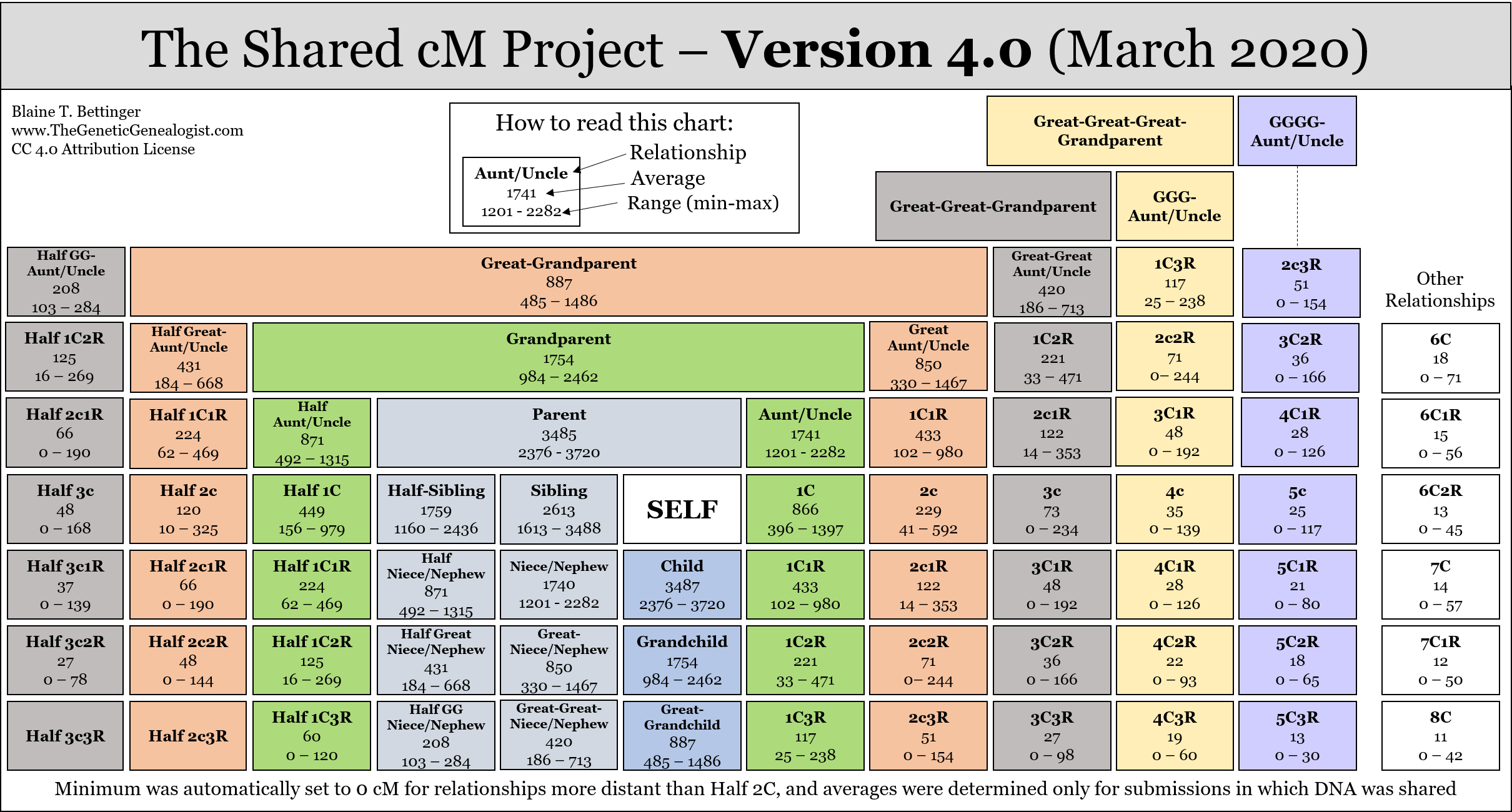
ISOGG's Cousin Statistics table shows the first effect. You can see that Ancestry can only detect about 11%  (about 1/10) of 6th cousins, and less than 1% (1 in 100!) of 8th cousins. The second effect is shown by the Shared cM Project of Dr. Blaine Bettinger, summarized in the table below. He gathers data from people who have DNA analyzed about their known relationships to DNA matches and the amount of DNA shared. The recent 2020 update summarizes over 60,000 data submissions. He generates a report that contains lots of useful charts, but the main one is this (click on it to make it bigger):


This chart shows what the actual reported amounts of DNA are for various relationship. So, for example, the ISOGG first chart shows that first cousins share on average 850cM of DNA. Bettinger's chart shows us that for first cousins (green box labeled 1C next to the central SELF box) companies are actually measuring an average of 866cM. But look at 5th cousins. ISOGG/theory tells us to expect about 3.3cM shared DNA. Bettinger reports that 5th cousins are reported, on average, as sharing 25cM, about 8 times what is expected. This is probably in large part because if the average is 3.3cM, but there is lots of variability above and below this, and everything below about 7cM (twice the expected average) is not considered, the reported average number will be much higher than the expected average. It is also likely for distant relationships that there are multiple relationships, each contributing some DNA, some of which the DNA matches don't know about.

So does this table help determine my Patchen relationships? According to this Shared cM Project table, 6th and 8th cousins are reporting, on average, 18cM and 11cM shared DNA, respectively. This chart says it's more likely that my Connecticut Patchen matches, all of which share 8cM with me, are 8th cousins. But if our Lemuels are the same person, which I think is true, two of these matches are known to be 6th cousins. How can that be? Take another look at the above chart. For 6th cousins, the range reported was 0 (in other words, not detected as a match at all) to 71cM shared. For 8th cousins, it was 0 to 42cM shared. So my 8cM matches could be in either one of these ranges. There are other numbers from the Shared cM Project (standard deviations) that I can use to nudge my opinion about these relationships, but while I can be confident that we are related, I can't identify the exact relationship.

That's a lot of work and explanation for a shoulder shrug, but it demonstrates limitations of autosomal DNA testing, especially for distant cousins, it showed how some useful tables and charts can be used in testing a relationship hypothesis, and it does show some evidence that our Lemuels are the same.

Sunday, September 1, 2019

Caseys in Galbally, Limerick, Ireland; Research resources

I recently made a DNA connection to a Casey family, and now am fairly certain that what I had suspected from census records, that Patrick Casey (b. ca 1801 in Ireland, married Hanora Norris in Galbally, where most/all of their kids were baptized) was a brother of Catherine Casey Cussen. This is just a note about some resources.

I've spent a lot of time going through church register images for the parish of Galbally, on the National Library of Ireland site ( https://registers.nli.ie/parishes/0264 ). The images are not indexed, so searching is like what we used to do when searching through census and newspaper films at local libraries. Except I can do this on my computer at home. I thought this would be a fairly quick job, but it turns out to be enormous. I'm looking for all Cushing and Casey entries to get a pool of candidates for the family in Ireland. It turns out there are about 500 images, most containing two pages from a register. I'm finding about two or three of interest per image. A baptismal record is typically a date, the child, two parents, two godparents, a page number, sometimes a note about the father's profession or town of residence, or that the child was "illegitimate", so typically about nine fields of information, often difficult to read. A marriage record is the married couple, two witnesses, a date (three fields), with occasional notes and a page number. At the end I add a film numbers, too, so that I can easily find the record again, so the whole is typically eight fields of information. That comes out to an estimate of about of about 2500 records and 20,000 recorded fields of information. So I should have expected a lot of work. I think I'm about halfway done.

The interesting part of this near drudgery is seeing all the names, something of a directory of neighbors of my Casey & Cushing ancestors. Many of the names are familiar as spouses of marriages that took place after immigration to the US, so I wonder if many of the Cushing & Casey kids and grandkids married into families the parents knew from "the old country". I've also seen some of these names in DNA matches to my dad, which opens some paths of searching for common ancestors. Some of the names that were very common in the Galbally register were Barry, Blackburn, Bourke, Brien, Butler, Byrrane, Carty, Casey, Clancy, Condon, Connor, Cronin, Cummings, Cunningham, Cussen/Cushen/Quishian, Dalton, Dawson, Dea, Donohoe, Dunn, Dwyer, Fitzgerald, Fogarty, Fraher, Fruin, Gorman, Grafton, Halloway, Hanrahan, Hayes, Heffernan, Henebry, Hennesy, Ivory, Kiely, Kirby, Landers, Lynch, Mahoney, Mara, Martin, Megrath, Moloney, Mullins, Murphy, Neil, Noonan, Picket, Power, Quain, Ryan, Sampson, Sheehan, Slattery, Sullivan, Walsh. And many of these added an O (O'Brien, O'Neal, O'Sullivan ...) or a Mc (McCarthy, McGrath, ...).

Another site I found interesting is the Irish Placenames Database at https://www.logainm.ie/en/s?txt=galbally&str=on . My browser identifies this as Dublin City University, but I don't know what exactly the project is. Often a register record would have a place name associated with a groom or a father, and the strange name and difficult-to-read writing made it difficult to record a meaningful place name. I didn't have a lot of success, but I found the resource interesting for locating on a map Irish place names more generally. This seems to be related to a project to preserve Irish culture by identifying and officially recognized places.

At the top of web page are links to what seem to be (a brief glance) other Irish collections. Above and to the left of the map is a link to "Meitheal Logainm.ie", which seems to be a place for people to submit local place names that may not be officially recognized, yet. But it's also searchable. I don't see any descriptions, but there are lots of places identified if you zoom in close. Some of the site are in the Irish language. ainm.ie seems to be a collection of biographies, but only in Irish. https://www.duchas.ie/en/ is a site collecting items to preserve Irish culture, through stories and photos. For example, I found this in their schools collection: https://www.duchas.ie/en/cbes/4922055/4848074/5009531 giving a local explanation of Galbally, which apparently means "town of the strangers".

A last resource, not new but perhaps you haven't seen it, is built around Matheson's statistics (published in a book that people have found very useful) about the Surnames of Ireland. I don't want to go look up the book right now, but from memory he summarized an enumeration of the births that took place in about 1890 throughout Ireland, and it is widely used to find to find families to help focus genealogy research to more likely areas of the country. The country had been decimated by famine related emigration, so the numbers and distributions of names aren't the same as they were in the 1830s and pre-famine 1840s, when most of my Irish ancestors lived there, but it is a valuable resource. Many of us bought the book to look through the tables of names, but now it is searchable online at https://www.ancestryireland.com/family-records/distribution-of-surnames-in-ireland-1890-mathesons-special-report/ . I had to try several spelling variants for Cushen to find the entry in their table, so you might not find your name on a first try. The book will show you all the variants that made up the head count. The book also has some explanation of origins of some names.

I'll post other resources as I come across them. Please post your own in the comments.

Enjoy!

Tuesday, July 30, 2019

My Genetic Genealogy: Is It Working?

The short answer is "that depends". Lots of work. Some important progress. So far, I'll give it a "thumbs up": yes, it's working.

It's been about a year and a half, now, that I've been chasing family genealogy through DNA. Here's what I've learned so far.
  1. The power of DNA matching is that it identifies for us persons who share identical segments of DNA, and so are likely related. It also estimates what that relationship is, based on how much DNA is identical and other proprietary tweeks.
  2. The DNA match information is a starting point, but we still must search for our common ancestors, the couple from whom we are both descended. Most of the matches shown are fourth cousins and more distant. Our common ancestors must be five generations or more back. I'll come back to this.
  3. Since less than half of DNA matches reply to requests for information, it is often necessary to research several generations of their ancestors, i.e., to do all the research unassisted. Among those who do reply, most have little information beyond their own grandparents, so a lot of work is still required to build their family trees.
  4. Different people undoubtedly have different goals in providing DNA samples for study. I've been researching family genealogy for 25 years and am not interested in finding more distant cousins. My goal is to extend my families back further in time than I have been able to uncover so far. Some have been adopted and are looking for birth families. Some are confirming or refuting rumored infidelities. I don't know what others are doing because they don't reply to my queries.
  5. Even though I'm not interested in fitting more cousins in my family tree, I need to do it anyway. An important clue when trying to extend and connect my ancestry is to at least identify which branch of my ancestry I'm trying to connect with. Second and third cousins allow me to identify which DNA segments come from which already known ancestors. When I find one of these segments in a more distant cousin, it at least helps me to focus my efforts on connecting to a particular ancestor couple.
  6. Genealogy DNA testing services differ. I have been using AncestryDNA, MyHeritage, and 23andMe.
    • AncestryDNA has the largest collection of clients, so may provide the best opportunity to find connections. Also, since Ancestry.com has been a genealogy research service, providing access to lots of indexed historical records and to customers' family trees, the matches are often more knowledgeable about their family history and have well-developed trees. Surprisingly, though, I still get replies to less than half of my queries. Ancestry will allow you to download your DNA analysis results, basically a map of your chromosomes, but it will not allow you to download DNA matches information to use with third party services or software. Since I'm not an Ancestry.com subscriber, I did find it frustrating, until recently, that I can't view family trees of matches. Ancestry is currently testing a beta version of their service, though. I can now view up to five generations of a tree attached to a DNA match. This has been very helpful. I've been able to see family tree connections now to dozens of DNA matches. (That's about a dozen per DNA kit. I'm working with DNA results for two relatives. Five generation trees have helped me find connections to about a dozen DNA matches for each of them.) After the initial excitement, I've come to three realizations: (1) most AncestryDNA subscribers don't have well-developed trees; (2) five generations allows me to connect with cousins withing my known ancestry, but does not allow me to see connections beyond my current known ancestry; (3) (not really a new realization, but commonly found in family trees) information in a tree is not necessarily true: some is contradicted by my records, and some is often copied from some other tree with no knowledge of where the original information came from; (4) AncestryDNA members seem to be very happy to provide access to their private trees when I explain how were related and what I hope to see in their tree and send them a link to my own online family tree.
    • MyHeritage is my preferred service because they allowed me to load raw DNA files downloaded from other services so that I can get matches to all four of my dna files (two parents, two in-laws). While they still allow you to upload DNA files, there are now limits on what information you may access. MyHeritage also allows access to customers' family trees. Most of these trees are either private or contain only a few individuals, but some are quite large which can make it much easier to find a connection. MyHeritage has a new feature that goes through their subscriber trees, through FamilySearch trees, and other available trees, and proposes connections with matches. It hasn't shown me an "important" connections, yet - and by important I mean one that I don't already know and that helped extend my tree back in time - but it might. It does not propose a lot of connections, yet, but it might be very useful especially for those whose trees are not yet very well developed.
    • 23andMe is not a genealogy records company. So unlike the above two companies, I never click on a button and get a message that I have to be a subscriber to use that function. They have a variety of interesting gene related reports, some regarding health predispositions, some regarding physical traits. While they do not have a family trees as part of their service, they do permit self-reporting of family surnames and locations, which is often helpful.
    • Note: I've read that the testing services may differ quite a bit in their accuracy with different ethnic groups or geographic origins. My ancestry is white European. I have noticed some inaccuracies that I don't understand. AncestryDNA often predicts a significantly more distant relationship than the true relationship and than I expect from the amount of shared DNA (where I assume a simplistic single path between matches). On the other hand, I'm finding many cousins estimated to be fairly close (third and fourth) are actually quite distant (6th and 7th). This latter only after lots of work tracing back so many generations. These cases seem to be for very old American families when there are multiple paths of relationship over many generations that must accumulate to as much shared DNA as a closer relative.
    • Note 2:
      DNA Matches by Service
      CompanyRelativeNew matchesMatches to Gr-parents
      23andMe
      Mother
      37D & L: 3
      C & H: 10 *
      H & M:1.5
      L & D: 17.5
      [closer: 5] 
      Father
      13
      C & C: 3 *
      P & D: 1
      W & A:  2
      W & M: 0
      [closer: 7]
      AncestryDNA
      Mother-in-law
      18P & C: 7
      H & C: 1 *
      C & K: 0
      K & R: 0
      [closer: 10]
      Father-in-law
      19M & W: 0
      C & McL: 17
      M & P: 0
      S & B: 0
      [closer: 2]
      MyHeritage
      Mother
      8D & L: 3
      C & H: 0
      H & M: 0
      L & D:4

      [closer: 1]
      Father
      31C & C: 2
      P & D: 27
      W & A:  0
      W & M: 0
      [closer: 2]
      Mother-in-law
      4P & C: 2
      H & C: 0
      C & K: 0
      K & R: 0
      [closer: 2]
      Father-in-law
      3M & W: 0
      C & McL: 3 *
      M & P: 0
      S & B: 0
      [closer: 0]

  7. Probably the reason that I have been most successful finding connections for my mom is that all of her ancestors immigrated to the US in the early to mid 1800s. So her family history is not that long, at least not in this country. For my dad, it's more complicated. Because most of his ancestral lines go back centuries in the US, it can be much more difficult to research all the way back to our common ancestor. Also, after so many generation, many of them in the northeastern US (or colonies), there has been a lot of mixing of ancestral lines, so there are multiple paths of relationship and, because each path adds inherited DNA, the estimated relationships implied by the amount of shared DNA may be in error by multiple generations.
The numbers in that table show that in the past year and a half I've made about 130 connections to relatives, with (only) one major find in each of our four parental lines (wife's parents and my parents). So, I'm certainly working hard. But I'm not sure I can sustain this level of effort to advance our tree. For now, I'm continuing with an emphasis on finding certain missing family members and specific pre-emigration families in Europe.

Friday, July 26, 2019

Evolving Genealogy Strategies and Successes

It has been frustrating tracing the Cushing family back beyond what we already know. In all fairness, we began by knowing a lot, since one of my uncles recorded the family genealogy in about 1931 in a  document untitled "Family History (Exclusive of Darwin's Age of Monkey)". My parents, my sister, and some cousins have travelled to the town and visited the church where many of Cussen family was baptized and where Dennis Cussen and Katherine Casey were married. One of the great milestones in American genealogy research is locating a family prior to emigration, and with this family we were fortunately handed that information before beginning our research.

Now, though, finding more information about the Cussen and Casey families is very difficult. There are very few records from the early 1800s and earlier. It could be that Dennis' father was a Francis Cushen who worked land in the Galbally area, but I haven't spent much time pursuing this because tithe applotment books do not list family members. Church records are rare before about 1825, so I've been unable to research there, either.

My principal strategy for extending the family backwards has been to publicly publish what I know about the family and to seek out genealogists in other branches of the family through which more information may have been preserved. While this has not extended my tree back in time, it has been very productive. Dennis and Catherine had about thirteen children. At the time I began my research, we knew descendants of only one other branch of the family. Of the remaining eleven children, three disappeared (appeared in only one record at some point) and one died unmarried at the age of 22. So that left seven branches of the family, perhaps some who had stayed in Wisconsin, to search for. Through the Internet, especially through message boards like Rootsweb and Genforum, I was able to contact four more branches. It turns out that one of the remaining branches left no children, hence no descendant genealogists, and the remaining two were women, for whom tracing marriages and name changes and moves can be very difficult. I was finally able to track the last two branches about two years ago. During all of this, we were able to share our respective genealogies and learn about the spread of the family. A disappointment for me, though, was that there was no documentation about our family prior to our Age of Monkey.

A second strategy I attempted was a search for Caseys. It turns out that a Casey family lived on the farm adjacent to the Cussen/Cushing family in Fort Winnebago in about 1850. I researched this Casey family and found that they had emigrated from Ireland at about the same time as the Cushings, that there was another closely related Casey family that also lived, albeit briefly, in Fort Winnebago, and that the Casey fathers, Patrick and James, were both just a few years older than our Katherine Casey Cussen. I thought there was a good chance these three were siblings. In the years since, however, I have found no evidence of a family connection. Meanwhile, with the explosion of paid membership-based genealogy services, especially ancestry.com, genealogy research has gone largely behind walls and I have made no contacts with the Casey family that I researched in and from Fort Winnebago.

Now, a new strategy has emerged: DNA. I've been researching DNA genealogy for about a year and a half, now, with disappointingly little to show for it. Perhaps that's too overstated. I feel that given the enormous amount of work I've put into DNA research, I should have more to show for it. But I see that I actually have made significant progress in several branches of the tree.

Yesterday, I was able to connect a DNA match back to one of the Fort Winnebago Casey families, one of my most important goals in my DNA genealogy research! The amount of shared DNA makes is very likely that Patrick Casey was indeed a brother to Katherine Casey Cussen. I was more confident of a close relationship between the two Casey men, since they were living together at one time, so James Casey is probably also a sibling. This gives me enormous incentive to start searching through online baptismal records at the National Library of Ireland to locate these Casey families. The kids were mostly born in Ireland in the late 1820s through early 1840s, and baptismal records were widely available.

Monday, March 6, 2017

Mayflower Ancestors

     I finally took some time to search for my Mayflower ancestors, and was surprised at how quickly I identified them.  So many people have researched their links to the Pilgrims that there are many well-researched biographies and genealogies published on line. So unlike my usual detailed search for birth, death, marriage, burial, census and other records, in this case I accepted biographies that show they were well-researched, some posted in recent years, some published over 100 years ago.
     I don't know an easy way to explain the path of the Mayflower ancestry line in words, so perhaps the following picture will help. [Click on the image to see a larger, more readable version.]

It shows the ancestors of Grandma (Harriet) Webber extending back to six Mayflower passengers:
  • William Bradford, originally from Austerfield, England, he was repeatedly elected Governor of Plymouth Colony. First elected when 31 years old, probably because so many of the colonists, including the first governor, passed away during their first few months, his leadership and relations with the native Americans were essential to the survival of Plymouth. He was the author of historically important documents describing life in the Colony.
  • Thomas Rogers, a fabric merchant, one of the many Puritans who passed away during the first Winter in Plymouth. (A son, John, left behind in Holland, who came to the Colony ten years later, is our ancestor.)
  • John Alden, a cooper crewman whose job was to maintain the all-important food storage barrels during the long voyage across the ocean.  John was given the option of staying in Plymouth or returning to England on the Mayflower, and chose to stay.  Alden was one of the founders of the town of Duxbury, Massachusetts.
  • Priscilla Mullens, only member of the Mullens family to survive the first Winter in Plymouth. She married John Alden. A famous fictional account of John and Priscilla's courtship is the subject of Henry Wadsworth Longfellow's poem, "The Courtship of Miles Standish". The Aldens had at least 10 children and have more descendants than any of the other Mayflower passengers.
  • William Mullens, Priscilla's father, a shoemaker, and ...
  • Alice Mullens, his wife.  Their 15 year old son, Joseph, also perished during the first Winter. 
      Mayflower passengers have been extensively researched and I'll leave the biographical details to those who have recorded them so well.

Monday, January 30, 2017

Mark Mathias Connell 1876 - 1957

   This is the 10th and last post following the family of George and Johanna Cussen Connell of Lodi, Wisconsin.
   Mark Connell, youngest of George and Johanna Cussen/Cushing Connell, was born in Lodi, Wisconsin in 1876. His father died just one year later. I think that Mark was living with his mother in Lodi then Portage until the mid 1890s, but I can't definitively locate him between 1880 and 1910. In 1910 I think he has just arrived in Seattle, since his occupation is listed as farmer, but he's living in a hotel in the city. By 1917, he was living in Burke, an unincorporated location that I cannot find on any map, where he runs a store. He married Loretta Hanson there that year. There was a post office there from 1907 to 1925, of which Mark was the postmaster in 1918. By 1920, they had moved to Eastside, Oregon (near Coos Bay) where Mark was a grocer. By 1930, Loretta and Mark were living in Pomona California, 50 miles east of Los Angeles, where they were running a pool hall and cigar store, which they did for many years. Mark passed away in 1957.  Loretta Connell Walters, remarried, passed away in 1990.  Mark and Loretta had no children.

Wednesday, January 25, 2017

Joanna Olive Connell 1866 - 1924

My eighth post in a series on the descendants of Johanna Cussen and George Connell of Lodi, Wisconsin.

Joanna was born in Lodi in 1866. She, too, headed to Chicago.  In about 1897, she married Edward H Kerrigan, son of Irish immigrants.  Their only child, Edward N, was born in 1901 in Chicago.  I'm not sure how specialized Edward's (dad's) work skills were.  In 1910, he is a "foreman in a plumbing supply house"; in 1920 a brass worker in a manufacturing plant. Joanna was a dress maker working out of the house in 1920, and they had bought a home on Gladys avenue, not far from where United Center is now. Joanna passed away in 1924 and is buried at Mt. Carmel Cemetery. Their son married Helen (don't know her last name) in about 1926. Edward H (aka Dad) passed away 1928 and is also buried at Mt. Carmel.

In 1930 Edward and Helen lived in Detroit, where he was an "ice machine" salesman, which is probably those new iceboxes. By 1940 he is selling refrigerators and they have bought a house. They had no children.  They probably retired many years later to Florida.  Helen died in 1987 and Edward in 1988.  They are buried in Largo, Florida.

Tuesday, January 24, 2017

Mary Connell 1865 - 1937

My seventh post in a series on the descendants of Johanna Cussen and George Connell of Lodi, Wisconsin.

Mary Elizabeth Connell is the only Connell who remained in Lodi. By 1895 she was a servant living in the home of Dr. George Irwin, a physician/surgeon in Portage.  The Irwin family moved to Lodi in the late 1890s and Mary stayed with them until at least 1910.  The 1920 census shows Mary as a 53 year old live-in nurse in the home of Mary Palmer and her unmarried sisters, they between the ages of 65 and 79. By 1920, Mary Elizabeth is renting a room in Lodi and has become a visiting nurse. She passed away in 1937 at the age of 72 and is the last to be buried (as an O'Connell!) with other family members at St. Patrick's Cemetery.

Monday, January 23, 2017

George Henry Connell 1865 - 1902 (part 2 of 2)


Going back to 1915 to follow up on the other kids ...

George and Mary married in about 1914.  Their first child, John, lived only two weeks.  Little George arrived in 1916, Helen in 1918 and Anna in 1920. George had also been working at Wells Fargo, but by 1920 he had found a new job as a foreman in a steel mill. (Read the Chicago Historical Society's excellent article about the history of steel mills in Chicago.) Something didn't work out between George and Mary, ending in divorce. In 1927 George remarried Melba Larsen, stenographer daughter of Norwegian immigrants. In 1930, George was doing clerical work for a machine factory, and by 1940 he and Melba were running a business, a "working man's supply store".  George and Melba had no children of their own. He died in 1963; she in 1980. They are buried, and I presume were living, in the Wisconsin Dells area, a popular outdoor vacation spot (fishing, camping, boating, etc., and in recent years water parks).  Meanwhile, Mary Sedlak Connell raised (or based on their presence in the census at least had primary custody of) the kids. In 1930, the kids aged 9 to 13 and in school, Mary was not working, so I wonder how she supported the family. She did have a boarder, and perhaps some help from ex-husband George or her own family. By 1940, Anna was no longer there. I was not able to find her again.  Mary and Helen worked packing candy, Mary part time and Helen full, though even Helen had only worked forty weeks in the past year.  George had completed high school and was working nearly full time as an accountant in a life insurance office.  They also still had a boarder. That's the last I know about their lives.  Mary was a factory worker at the time of her death in 1957, at the age of 63. I could not find Helen again. I think I found son George buried in Brooks, Wisconsin, just a mile and a half from where his father was buried. Social Security records show a last known address in Chicago, so I have some uncertainty.  Assuming for now that our George is buring in Brooks, he was married to Joanne who died in 2002 and is buried there with him.

That brings me to the John, the third of George and Ellen McCabe Connell's children. In part 1 I mentionned that John married Josephine Huntscha, daughter of German immigrants Emanuel and Agnes Huntscha, in 1917 and was living in an increasingly crowded house with Mom and sister Theresa's family. At that time he was working for the US Army in a Chicago supply depot. By 1920, John and Josephine had found an apartment of their own, John was selling electrical supplies and their daughter, Ruth was a year old. Jack, jr. was born in 1921, Marian in 1921, Chuck in 1924, and Nell in 1931. I couldn't find the family in 1930, but by 1940 John and Josephine had started a "lunch room" restaurant. Josephine and the kids (once they were in high school) waited tables there. Sometime in the late '40s, John and Josephine acquired (don't know whether they purchased or built it) the Parker Lake Resort in Oxford, Wisconsin, in the Wisconsin Dells. I imagine these were rental cabins or a motel on the lake with a swimming area.  They had been operating the Resort for about 25 years when John passed away there in 1972. He appears to be buried by himself near Oxford, so I imagine that Josephine sold the Resort and moved away. (On the other hand, free online burial records are far from complete, so she be buried nearby, too.) Having little information, I can't tell the the order of events in the kids lives. And I don't want to mention the grandchildren as many of them are probably still living.  Ruth and Chuck operated a couple of restaurants: Connell's in Chicago and Murphy's Romeo Cafe in Romeoville.  I can't tell when and for how long they operated the restaurants.  Ruth married John Regan.  She died in California in 2003.  Chuck was living in Sheboygan, Wisconsin, having completed college, when he married in the early '50s. He passed away in St. Paul, Minnesota in 2000. I believe Jack, jr. was living in Chicago in the early '70s, but have no information on marriage or family. I know only that Marian was married with the last name of Healy when she passed away in the Chicago area in 1967.  Nell married in the early '60s, also after completing college. I believe they raised their family in the Pittsburgh, Pennsylvania area.  The youngest of John and Josephine's children, she was the last to pass away, in 2015.

Sunday, January 22, 2017

George Henry Connell 1865 - 1902 (part 1 of 2)

A fifth post in a series on the descendants of Johanna Cussen and George Connell of Lodi, Wisconsin.

George continued the Connell exodus from Lodi to Chicago. Last recorded in Lodi as a 15 year old school boy in 1880, he married Nellie McCabe in about 1890 in Chicago. I had a hard time finding any information about Nellie. She (10 years old) and three of her siblings - Anastasia (8), Owen (8) and John (6) - were living in St. Joseph's Orphan Asylum in Chicago in 1880. (This is now the Cardinal Meyer Center.) One historical account of such institutions claims that most children in orphanages in the 19th century weren't actually orphans, but rather from single parent families in financial crisis. (Read the Chicago Historical Society's excellent article about the history of Chicago orphanages.) One record indicates that Ellen's father was Pat McCabe, but I haven't found any records of their family.  Nellie and George had three children in Chicago: Tessie (b. 1891), George (b. 1894) and John (b. 1897). In 1900, George was operating a saloon. [This may be a clue to Nellie's family. A Pat McCabe who ran a saloon in Chicago died in 1890, the same year that Nellie married George.  Perhaps they took over her father's bar? Perhaps his wife passed away in the late 1870s and a single barkeeper could not take care of four children under the age of 5, and brought them to the orphanage, expecting to remarry and retrieve them? I'll need more information to figure this out.]  George and Nellie and family lived near the stockyards. In 1902, George passed away.  Spouses dying and leaving widows/widowers with young children to raise seemed to be a macabre pattern in the family: George's father in 1877, one or both of Ellen's parents in the late 1870s, Catherine's husband in 1896, Maggie's husband in 1898, and now George.

Nellie raised the kids in Chicago. It looks like they moved into a smaller home in the Chicago stockyards area, south of the city, shared with meat workers.  The kids were working in 1910: 19 year old Theresa was getting paid to play the piano in "the park" (don't know if this was a park, or the name of a bar?), and 15 year old George was an office boy in a meat packing plant. 13 year old John was still in school. In 1913, Theresa married Daniel Bross, a clerk at Wells Fargo recently transferred (?) from New York City.  In about 1914, George married Hungarian-born Mary Sedlak. And in 1917, John married Josephine Huntscha, daughter of German immigrants Emanuel and Agnes Huntscha. By 1917, George and Mary had moved to their own apartment, but the grandchildren had been arriving at home. The family needed more space and, probably with the help of Daniel's while collar pay, could afford to move down the street.

By 1920, the kids were all raising their own families. Daniel was now keeping books for a meat business. Big changes had taken place in the "express" business (I "express" means fast transportation of people or things, a major part of Wells Fargo's business in the early '20s.) I don't completely understand,  but the US government forced the consolidation of the many express businesses in 1918, for some sort of war-related need. I believe that Wells Fargo had to close many, perhaps thousands of express business offices across the country, and Daniel may have lost his job there.  Nonetheless, their still fairly new quarters was now principally the Bross home, housing Theresa and Daniel, their three children - 5 year old George, 3 year old Helen and nearly 2 year old Bernadette - and Mom/Grandma, 49 year old Nellie. Sadly, young George passed away later that year. Three more kids arrived in the '20s: Daniel, jr. (b. 1921), June (b. 1923) and Loretta (b. 1928). By 1930 Daniel and Theresa had bought a house in the rapidly growing suburb of Homewood. Daniel was now doing clerical work in a dentist's office.  Whether working in the suburbs or riding one of the many new commuter trains into the city, I don't know. Two days shy of her 62nd birthday, in 1931, with 12 grandchildren, Nellie passed away. The Depression hit Homewood very hard, many losing their jobs and some their homes. Many lost their savings when the local bank closed suddenly in 1932. With few passengers to transport, the commuter trains to Chicago dwindled to just a few a day. The Bross family had moved back to Chicago and was renting a home there when Daniel passed away in 1938. In the last available census record, 1940, Theresa and all five kids, ages 11 to 23, are together.  The older kids were probably helping to pay the bills: Helen, Bernadette and Daniel, Jr. were all working in dental offices. Mom/Theresa took care of the home and June and Loretta, (16 and 11), still in school. Theresa passed away in 1978. I have little detail, and don't wish to post names of living children on line, but I do know that all five Bross kids married and have passed away.  All but Daniel, Jr. remained in the Chicago area.  Helen Bross Hattendorf passed away in 1981; Bernadette Bross Kissel in 1989, Daniel in 1995, June Bross Kosmos in 1989, and Loretta Bross McCaffery in 2004.

To be continued ....

Saturday, January 21, 2017

Ellen 1861 - 1931 and Alice 1875 - 1966 Connell

Like her older sister, Ellen Connell also left for the Windy City. Since I have no information about them in the sixteen years from 1880, when they were both living at home in Lodi, to 1896, when Katie's first child was born in Chicago, it could be that they went to Chicago together.  When I first find Ellen in Chicago, she is 39 years old and living with her youngest sister, 24 year old Alice.  Both of them are dressmakers and seem to have plenty of work. In 1910, Ellen is still making dresses but living on her own. I can't find any record of her in subsequent years, until her death at the age of 69, still a dressmaker living in Chicago, in 1931. She is buried with her parents in St. Patrick's cemetery in Lodi, Wisconsin. (Her tombstone uses the name O'Connell.)

Alice seemed to live a whirlwind next 10 years. In 1904 she was married to Alfred Feiss in Denver, Colorado.  I haven't extensively researched this, but I believe that Alfred was the son of Adolph Feiss, the founder of San Francisco's Emporium Department Store. In 1910 I find them in Charleston, South Carolina, where Alfred's occupation strangely says just "Income". In 1911, Alfred was buried in Toledo, Ohio, next to Adolph and Laura Feiss, his parents. Alice and Alfred had had no children.  When Alice next appears in public records, she in a 57 year old widow, living in Portage. She remained in Portage until her death in 1966. (Death records say she died in Baba, but I haven't been able to figure out what this might mean.  There is no Baba, Wisconsin.  Perhaps nearby Baraboo?) She is buried by herself - at least, not with her family in Lodi, and not with husband Alfred - in St. Mary's Cemetery in Portage.

Friday, January 20, 2017

Only the Good Connells ... and the Common Connells

There must have been some sort of sickness in the Connell house in 1873. On March 13, 15-month old Frances passed away.  Just 6 days later, her 6 week old little brother, William, died. If not a sickness that afflicted the children, perhaps this was a tragedy related to the recent birth - a post partum depression or an inability to provide adequate care for the infants.  The next Connell born, Daniel in 1874, would also die young.  He was about 14 years old in 1888 when he passed away.  All three of these children are buried with their parents in St. Patrick's cemetery in Lodi. (As with the other family members buried at St. Patrick's, all their headstones say O'Connell.)

Although chronologically out of order, there are two other children about whom there is little to say.  John is 18 years old and in school when last seen with the family in Lodi in 1880. James is a 12 year old school boy that year, then seen just once more as a 31 year old unemployed salesman living with his mother in Portage in 1900. It is likely that they are in census and other records that I have seen, but their names are so common that I can't tell which ones are our family unless I find a mention of a mother's maiden name. For now, they remain unknown.


Thursday, January 19, 2017

Katie Connell 1859 - 1944

Katie Connell was the oldest of George and Johanna's children, born in 1859 in Lodi. It's curious that per the 1940 census Katie had an 8th grade education, while the 1880 census says that 20 year old Katie was attending school. She moved to Chicago where she met Henry Heseltine, a recent immigrant from England. They probably married in about 1894, the year he became a US citizen.  Their daughter, Elizabeth was born in March of 1896 and Henry died just three months later.  The census says Catherine was a "compositor" - a typesetter for a printer - until at least 1910. I assume that Catherine struggled financially, since they moved from town to town, always near Chicago - Cicero, Oak Park, Harvey, Chicago, Villa Park - and her work changed to housework/servant/janitor. Elizabeth attended two years of college and became a public school teacher, living with her mother until her marriage in about 1921.

Elizabeth married Herman Kaehler, a Chicago cab driver.  Herman was a military veteran, though I don't know which conflict, if any.  He was a widow with four children - Ruth, Hazel, Marjorie and Patricia - aged 11 to 4 when he married Elizabeth.  They had all been living with his parents in 1920, and the kids were not with him in subsequent censuses, so I wonder if they were raised by their grandparents. I may have found Hazel (married name Miller) living in Deerfield with her husband and about four kids.  I believe she passed away in 1998.  I could not find the other kids as adults.

Herman Kaehler and Elizabeth Heseltine married in about 1921 and by 1930 had four children.  I'm not posting their names since some of them may still be living.  I think that life was hard for Herman and Elizabeth, too, though this may have been the norm during the Depression.  I can't find the family in 1930 in the census.  In 1940, Herman claimed a profession of brick layer, but had not worked in over a year. He was receiving some income, perhaps from a veteran's pension.  Elizabeth had a public works job as a nursing (?) school director.  Their 17 year old daughter was still in school, but their 16 year old son was not.  With an occupation of "new worker", not having found work in 13 weeks, with a 9th grade eduction, and being only 16 his prospects were probably not good. I was not able to find the kids as adults, nor death information for Herman and Elizabeth.  Elizabeth's mother, Katie Connell Heseltine, passed away at the age of 85 while living in Villa Park, near Elmhurst.  She may have been living with the Kaehlers. She is buried in Mt. Carmel cemetery in Hillside, Illinois.

Wednesday, January 18, 2017

George and Johanna Cussen Connell in Lodi, Wisconsin ca. 1870

I sat down for a few hours to gather more information on the children of Johanna Cussen Connell.  Four days later, I'm posting some articles about these families.  As usual, dates and places only tell me where they lived. If you are related to any of these families and can share stories or more information, please contact me (find my e-mail in my "profile" link) or post a comment.


Johanna Cussen was born in Galbally, Ireland in 1836, travelling with her family to Newfoundland, Boston, and Fort Winnebago by about 1848. In about 1858 she married George Connell/O'Connell, I believe a recent immigrant from New Brunswick, Canada, and they settled in Lodi, about 25 miles south of Fort Winnebago. They were farmers. From 1860 to 1876 they had thirteen children in Lodi.  George died in 1877, leaving Johanna with 11 children between the ages of 1 and 18. Information is sparse, but I assume that life was difficult. Usually, someone stays with the elderly parent and works the farm, but by 1895 Johanna had moved to Portage, presumably having sold the farm, where she remained until her death in 1923. She is buried in the Catholic cemetery there with her husband, George, the three kids who died as children (Frances, age 2, William, age 1 month, Daniel, age 14), Mary, the lone daughter who remained in Lodi as an in-home servant and nurse her entire life, and Nellie, the only child to be returned to Lodi for burial.

I initially thought this family name was O'Connell.  Indeed, I stumbled across Johanna on FindAGrave.com, where volunteers post inventories of cemeteries, usually with photographs. Johanna Cushing O'Connell's grave marker is shown there, in St. Patrick's cemetery in Lodi, Wisconsin, as are five other members of the O'Connell family.  Having just extensively searched for George and Johanna's descendants, however, I now know that the cemetery is the only place where the name O'Connell was used. All appearances in the census, newspapers, birth, marriage and death records, etc., use the name Connell. The use of O'Connell in the cemetery is a mystery to me. I would suspect that a well-meaning descendant just got it wrong when they replaced headstones, but the stone for George appears to be an original (at least it looks very old), and it does say O'Connell.

I'll trace their descendants in the following posts.

Monday, October 26, 2015

Elizabeth Langham Cushing Most Interesting Person in Portage Wisconsin, 1931

I just stumbled across a recent article about Elizabeth Langham Cushing, wife of James Cushing of Fort Winnebago, Wisconsin, cousin to our great-grandfather Francis Cushing. It having been published earlier this year, I felt that copying it here would be a copyright violation.  The article is located at http://www.wiscnews.com/news/opinion/column/article_42048805-a475-5bd9-b882-34c3a7f7d4ea.html  . It cites an original article by Zona Gale, a well-known Portage author.

Briefly, Ms. Gale, who, by the way, was a close friend of Elizabeth Cushing, describes her friend as an exceptionally fair Justice of the Peace, and a single mother who, in addition to raising her twin daughters, provided food, shelter, clothing, a bath, etc. to a constant stream of down-on-their-luck people who showed up at her door. I'm not sure what was in Gales' original article and what was added by subsequent authors, but Elizabeth had also traveled in Europe, lived in Italy, lived in a Nevada mining camp for 20 years, and became a highly respected and prominent Justice of the Peace. My addition: She was a member of the Progressive Party and was active in the presidential campaign of Wisconsin senator Robert LaFollette. Her daughter, Rachel, once told me that Elizabeth was very active in women's rights causes. (According to her obituary, Rachel remembers having to carry a banner with her mother and sister in a march for a Women's Right to Vote. A neighbor called out "Mrs. Cushing, go home and cook dinner for your family", to which Elizabeth replied "I have a pot roast in the oven. I think I'll keep marching.")

Elizabeth died in 1932, one year after Ms. Gales' article appeared, from injuries suffered in an automobile  accident.

The information in the recent online article originated in an article titled "Interesting People, Zona Gale Talks About The Most Interesting Person in Her Hometown", written by well-known Portage author Zona Gale, published in the November 1931 edition of American Magazine. It subsequently was used by Dorothy McCarthy for an article in her weekly "Tales of Old Portage" column in the Portage Daily Register (which appeared from 1958 to 1975). It's third incarnation is a collection of Ms. McCarthy's articles published by the Portage Historical Society in a book also titled "Tales of Old Portage". The fourth telling of this story is the recent WiscNews.com article by Joanne Genrich, posted earlier this year. I suppose this post might be considered yet a fifth account (a great grandchild of Gales' article?).

Sunday, April 12, 2015

Cushings of Fort Winnebago, Portage and Lewiston, Wisconsin

[A very frustrating experience at the library.  Found hundreds of newspaper articles including Cushings and Caseys in the Portage newspaper database at the library.  I emailed all my findings to me, then find that only the titles were sent, not the text information. But, there were a few that I remember.  I'll report more precisely when I go back and copy the articles.]

One of the articles reported four marriages that took place at St. Mary's Catholic church in Portage one day.  Two of the brides were Cushings.  One was Nellie, daughter of John, who married Dennis Callahan.  The other I don't remember exactly, but married McSorley (from Texas, I believe) and was from one of the Portage or Lewiston Cushing families.  The article stated that the two brides were no relation to each other, which (if accurate) answers a question we've had for many years. So our Cushings of Fort Winnebago were not, at least closely, related to the other Cushing families in Portage and Lewiston. 

Johanna Cussen/Cushing O'Connell of Lodi, Wisconsin

I've found the last of the known daughters of Dennis and Catherine Casey Cussen/Cushing.

Johanna was born in Galbally in 1836, travelling with her family to Newfoundland, Boston, and Fort Winnebago by about 1848. In about 1858 she married George O'Connell, I believe a recent immigrant from New Brunswick, Canada, and they settled in Lodi, about 25 miles south of Fort Winnebago. They were farmers. From 1860 to 1876 they had thirteen children in Lodi: Katie (1860), Ellen (1861-1931), John F (1863), Mary E. (1864-1937), George, Jr. (1865), Joanna (1866, m. Edward Kerrigan), James E. (1868), Maggie (1869, m. John Bastian 1906), Frances (1871, died 1873), William (1873, died at 6 weeks old), Daniel (1874, died in 1888), Alice (1875), and Mark (1876). George, Sr. died in 1877, leaving Joanna with 11 children between the ages of 4 and 17 and a farm to run.  I have no records over the next 20 years, so don't know how she managed. By 1900, Johanna was living in Portage, near Fort Winnebago, with only James remaining at home.  She remained in Portage until her death, in 1923, and is buried with her family in St. Patrick's Cemetery in Lodi.

A side note: In 1860, 27 year old Michael Welch, also from New Brunswick, was living with George and Johanna.  Ten years later he married Johanna's younger sister, Ellen Cushing. A brief google indicates that Michael's mother's name may have been O'Connell, so he and George may have been cousins.

Another side note: As I research Johanna's family, I find that their last name is O'Connell only on the markers of their Lodi graves. George O'Connell's marker looks to be an original tombstone, strong evidence of the last name O'Connell.  Nonetheless, every other record I've found, for generations, gives a last name of Connell and I've decided to use this as the family name.

Saturday, October 4, 2014

Irish Origins

If you're Math-phobic, skip this article.  It will explain and demonstrate a proposed method to assist in locating Irish ancestors.

A valuable resource used to trace families back to Ireland is Sir Robert Matheson's Surnames in Ireland (1909). One of my first posts showed how common (or rare) some of the Irish surnames in our family tree were in Ireland in the 1800s, when all of our known Irish ancestors came to the United States. The bulk of Matheson's report is a table showing the number of births registered for every surname (family name) in Ireland in 1890, and the distribution of these births by province (Leinster = eastern Ireland, Munster = southwestern Ireland, Ulster = northern Ireland, Connaught = mid-western Ireland).  Some of the important things to know about this index are: (1) related names are combined and reported as the most common name; (2) 1890 is after the Great Famine (aprox. 1845 to 1852) and deaths and the enormous exodus of emigrants from Ireland in the mid and late 1800s had decimated the population (Population was growing very rapidly before the Famine, peaking somewhere around 8 million people, but was down to about 3.5 million at the time of Matheson's data in 1891), so this data may not accurately portray the distribution of families in the early 1800s; and (3) rare family names, for which less than 5 births were registered throughout Ireland, are not included. In spite of the limitations, because of the sparsity of census-like information in Ireland, this is a valuable resource.

I have used this book from time to time to give me a general idea of where a branch of my Irish ancestors came from. Because comprehensive searching of data has not been easy (at least in the past), I have not actually found any of my ancestors using this data.  But I hope to.

It has occurred to me that this information can be used mathematically to narrow a search for an ancestor. The listings in Matheson's table are essentially the probability of finding a family with this surname in the various provinces.  Using Hogans as an example:

Surname    Births in:        Ireland              Leinster             Munster            Ulster            Connaught
Hogan                              193                    59                     115                   5                     14

can be recalculated as

Surname    Probability of birth in:  Ireland      Leinster         Munster            Ulster            Connaught
Hogan                                          100%          31%              60%                 3%                   7%

[Because of rounding, numbers don't add to 100.] So I would expect that my Hogan family was most likely from southwest Ireland, but may also have been from eastern Ireland. It is unlikely they came from northern or western Ireland.

I recently found a marriage record that Mrs. Hogan's maiden name was Rice. Matheson's data for Rice is:

Surname    Births in:      Ireland              Leinster             Munster            Ulster            Connaught
Rice                                 99                     33                     18                   48                     0

and can be recalculated as

Surname    Probability of birth in:   Ireland        Leinster       Munster         Ulster         Connaught
Rice                                               100%           33%            18%             49%               0%

Nearly half of the Rice families were in northern Ireland, where there weren't many Hogans, but there were many in eastern Ireland and several in southwestern Ireland. By combining this data, multiplying the probabilities that both families were present in the province, and normalizing:

Surnames    Probability of marriage in:   Ireland      Leinster     Munster     Ulster      Connaught
Hogan-Rice                                           100%         46%           49%         6%              0%

Note that this method assumes that the bride and groom were actually from the province in which they were married. In this case, a Hogan and Rice married in Ireland were likely from eastern or southwestern Ireland, only slightly different from the conclusion I would have drawn from considering Hogan alone.

Applying this to the other families in our family tree for which I know both surnames:

                   Probability                                                                                                        Start in
Surnames   of marriage in:   Ireland      Leinster      Munster       Ulster       Connaught      counties:
Hogan-Rice                        100%          46%           49%            6%              0%             Dublin

Donnelly-Larkin                  100%          38%            7%           50%              5%       Dublin, Armagh

Cushing-Casey                   100%            6%           87%            0%               8%       Cork, Limerick

Casey-Brady                      100%          60%           12%          20%               8%            Dublin

Shannon-McHugh              100%            5%            2%            56%             37%             ?
Waters-Murphy                  100%          24%          76%             0%              0%          Wexford
Murphy-Stafford                 100%         78%             9%           13%             0%       Wexford, Dublin

Unfortunately, I don't think the underlying data for this table still exists.  If it did, we could further analyze this data by county.  In Matheson's table, he also indicates in which counties the most births occured.  Using these (unquantified) indicators, I estimated the most likely counties in my table, above.  The only test I have on this method is that the Cushing-Casey family is known to come from Co. Limerick, near where it joins Cos. Tipperary and Cork. The table above tells me that the family was very likely from Munster province (correct), and the county notes would have sent me to Cork and Limerick counties.

Unfortunately, at this time, there are very few couples in my tree that were married in Ireland and for whom I know the wife's maiden name. In the table above, only three are direct ancestors, and for the one most strongly placed (Cushing-Casey) we already know where they're from.  The other four families are parents of in-laws in my tree to help others connect to our family, but not of enough interest to search their origins.

Monday, September 15, 2014

Cushings: Our Viking Origins

[posted 15 Sep '14; added to web site 23 Jan '15] Our known genealogy only goes back a few hundred years: to the early 1800s for most of our branches, to the early 1600s for some.  While searching for Cushings in Ireland, I've browsed several books that either claim to know or speculate about the origin of the name and how Cushings came to be in Ireland. The one thing they all agree on is that Cushing is not a native Irish name.  I've included some of the different origin theories on the Cushing page of my genealogy web site.  The one most interesting to me, though I have not found any research to support the specific link to the Cushing family, is that Cussen (and like names) is derived from "Cu's son", Cu having been a Viking land owner in the vicinity of Galbally.  On the other hand, the most widely accepted theory is that an English knight with a name like Cousins came to the Cork area during the Norman Invasion of Ireland in the late 12th century.  [While the primary invasions occured in 1169 (eastern Ireland) and 1171 (eastern and southern Ireland), the influx of people from Normandy continued through about 1190.  All of this is considered the Norman Invasion.]  Over the centuries, they were "hibernicized", losing their foreign identity and becoming "Irish".  They had estates in the Cork area, until these were taken away and given to the Bowen family (Bowens Court) in about 1662 as part of the policy begun by Cromwell to replace the Irish with English. This once prominent family is taken to be the source of the Cushen and related families in Munster province (southern Ireland).

Rendering of what a Viking Cushing may have looked like [ 8-) ]
Recently, I was reading through the introduction to a well know Cushing genealogy, The Genealogy of the Cushing Family, An Account of the Ancestors and Descendants of Matthew Cushing, Who Came to America in 1638, the 1905 updated edition by James S. Cushing. In it he presents research that says that a great Viking warrior, son of the Viking conqueror of Norway, was exiled from Norway in about 900 C.E. He and his large group of followers eventually landed in what is now France, taking and settling a territory that came to be known as Normandy. (Norsemen, from Norway, conquered Normandy, ...)  Skipping 150 years of genealogy, descendants of these Vikings included William the Conqueror and his nobles, who conquered England in 1066 CE and issued lands and titles to his kinsmen, including one who had adopted the surname Cusyn.  So skip ahead another 120 years or so to a Cusyn descendant that took land in southern Ireland and established the Cushens of Munster Province. (By the way, descendants in England became the Cousins and Cushings and related of England, one of whose families was the subject of this Cushing genealogy book and to whom most of the Cushings in North America can trace their roots.)

The irony, then, is that whether you accept Cu, the Viking who conquered land in southern Ireland in the 9th or 10th century CE, or a Cousin nobleman who arrived during the Norman Invasion, a descendant of Vikings who conquered Normandy in the early 10th century CE, the origin of our Cushings is likely, ultimately, Viking.