Sunday, December 20, 2020

GEDMatch

For years, I avoided GEDMatch, fearing as-yet-unknown risks of publicly posting DNA. Recently, having discovered that close relatives had already posted their DNA on other DNA matching sites, I decided to try GEDMatch. Here are my first impressions.

Cons:
(1) I found no first cousin or closer relatives on GEDMatch, making my DNA a sole source for identifying close relatives. I may have my DNA deleted from this service.

(2) Because there are no close relatives among my matches, it is exceedingly difficult to identify any matches.

(3) Gathering match segment data, needed to determine common segments between matches, is tedious using the free version of the service. This information must be gathered individually for each match. There is a paid version of the service, and I don't know if gathering segment is any easier with it.

(4) For now, as a newbie to GEDMatch, I'm concerned about determination of amount of shared DNA. Often, a cM amount that is given in the list of matches does not correspond to the sum of the segments. Often, when I find that the same individual is listed on a different DNA analysis service, the amounts of DNA shown by the two services is significantly different.

(5) The ethnicity estimating tools are much less precise, geographically, than available at other services.

(6) There is no ability, at least in the free version, to annotate or tag matches as you identify them, something available in the other services.

Pros

(1) It's free.

(2) Using the free version of the service, it is easy to gather a list of matches, a list of common matches, and a family tree (if available). Note that I use Pedigree Thief (a Chrome extension) and Genome Mate Pro to harvest information and keep track of my research. 

(3) Email addresses are available for each match. (Though I have not tried any, so don't know to what extent they are valid.)

(4) There are many matches at GEDMatch that I don't find on the other services that I use. However, since I'm having trouble identifying these matches, this may not be useful.

(5) You can upload your DNA file from any testing service. Ancestry and 23andMe do not allow this. MyHeritage does allow this, though I'm not sure what limitations they currently impose on free uploaded DNA data vs. DNA analyzed at MyHeritage. 

At this point, I would not recommend GEDMatch unless you are an advanced DNA user with an extensive tree and many DNA matches identified with other services. (It's possible that the lack of close matches is an anomaly for my DNA and others would benefit more. I have no knowledge of this, yet.)

Book: The Dublin Saga by Edward Rutherfurd

The Princes of IrelandEdward Rutherfurd wrote a pair of historical fiction novels called The Dublin Saga: The Princes of Ireland (2004) and The Rebels of Ireland (2006). I don't generally enjoy non-fiction, so these types of books are my way of learning some history and, more enjoyably, getting an historical setting for people and places in my family history.

The Princes of Ireland begins with mythical peoples and progresses through the druids, Christianity, the Vikings, conquest by England and subsequent centuries of rule. The Rebels of Ireland continues from about 1600 with the powerful animosity between Catholics and Protestants, the constant back and forth between British rule and Irish independence, takes us through the horrible Great Famine, the schism between Ulster and Catholic Ireland, rebellions, the rise of Sinn Fein, and through the partition of Ireland. I found especially interesting the intertwining of the American Revolution, relationships with France, massive emigration to America, which were occurring in about the same time period as the emigration of our Irish and French ancestors to America. The descriptions of the religious animosities between Catholics, Protestants, and Puritans added context even to the earlier emigration of Puritans to the New World, also part of our family history.

Though the saga is principally located in and around Dublin, the famine takes place mostly in Ennis, in west Ireland, and some of the stories include other counties. In Princes, Rutherfurd explains origins of many place names and families. Written very recently, he explains that the historical context that he portrays includes the current understanding of Irish history. I enjoyed these books immensely.

Sunday, August 2, 2020

New Family Tree

I've finally gotten a family tree back online! This time it's located on my own genealogy web site at https://cushings.com/roots/public_tng/ .  (Also in the list of links to the right.) A few things are different. I've used a php package called The Next Generation (TNG). It took a few days to get it installed, and another few days to test it's features, privacy, security, and whatnot to make sure it met my needs. The advantages over my previous Rootsweb installation are that it is online (Rootsweb trees went offline for about a year), it allows researchers to contact me (the new Rootsweb had no attribution or contact for the tree owners), and the search and display and look and feel of the web site is so much better than what Rootsweb offers (or at least what it was offering when I finally removed my tree about a year ago). The advantage over an Ancestry tree is that I can make this available to the public. (You have to be an Ancestry subscriber to see Ancestry trees.) Other services offer tree space, but with a tree as large as mine I either needed to pay for space or allow others to collaborate on my tree, or other features that I don't need. I've also changed what information I'm making available. I'm just including a skeleton tree of direct line ancestors to help me better focus on extending my own tree. By including just direct ancestors, I'm hoping to connect with people whose own trees meet mine at its oldest branches. At least that's the hope. We'll see.

If you search my tree and you don't see a family you're looking for, but you know I'm related because I've mentioned someone in a blog post, or on my genealogy web site, please contact me. I'm happy to look for and share more information.

Thursday, June 25, 2020

DNA Case Study: Lemuel Patchen and Limits of Autosomal DNA Testing

[Minor corrections made 31 August 2020.]

We've traced our Patchen ancestors back to a Lemuel Patchen in Ontario, Canada in 1820, and his son, Thomas. Thomas was born in Canada in about 1796. Other than one census record, there is no other information on this pair in Canada. Other Patchen researchers speculated that our Lemuel was the same who had abandoned his family in the early 1790s and headed into Canada. This Lemuel was part of the extensively researched Patchen family of Connecticut. I described the details several years ago in another blog post: http://ourfamilyforest.blogspot.com/2012/07/lemuel-patchen-1770-1850s.html .

Recently, I had my DNA analyzed at Ancestry.com, and have found several DNA matches to Patchen descendants. Four of them are descendants of Thomas and, since I have quite a bit of information on our Patchens, were easily placed in my family tree as 3rd and 4th cousins. Four others, though, seem to have genealogies connecting them to the Patchens of Connecticut. Two are descendants of Walter Lockwood Patchen, a brother of Lemuel Patchen, both sons of George Patchen, born in 1737 in Wilton, Connecticut.  If we are descended from this Lemuel, these DNA matches are 6th cousins of mine. Two others are descendants of Ann Patchen Morehouse who, according to the extensively researched genealogy, is the daughter of Jabez Patchen, a first cousin to George. This would make me an 8th cousin to these DNA matches. I will mention, though, that there are some who argue that Ann Morehouse was not the daughter of Jabez, that her father was actually George, father of Lemuel and Walter. So her descendants may actually be 6th cousins, also.

Can the DNA analysis tell me if our Lemuel is the son of George Patchen of the Connecticut Patchens?

To answer that, lets look at the numbers. All four of the Connecticut Patchens share 8cM of DNA with me, and all are estimated to be somewhere between  5th and 8th cousins. The good new is that 8cM (cM indicate how likely it is that DNA is inherited), while small, is not insignificant. So it is likely, especially with several matches, that we are related to the Connecticut Patchens. Is our Lemuel the son of George Patchen, who left to Canada? There are some useful charts that might help.

A good resource for using DNA for genealogy is the International Society of Genetic Genealogy (ISOGG). A table on their statistics wiki page (Average autosomal DNA shared by pairs of relatives) shows how many cM of DNA are expected to be shared for different relationships. There is a lot of variability in the amount of DNA inherited from a specific ancestor, so the numbers in this table are the expected average values. The last line of this table shows that 3.32cM, on average, will be shared by 5th cousins. If you read the whole page, or study the table, you'll see that the average is divided in half for each additional generation of ancestor. For example, 4th cousins share 1/4 as much DNA as 3rd cousins. In the table 3rd cousins share 53cM of DNA, on average, and 4th cousins share about 13cM of DNA, about 1/4 as much. In this Patchen example, we're looking at 6th or 8th cousins, so take the last line of the table (5th cousins share on average 3.32cM of DNA) and divide repeatedly by four to see that sixth cousins share about 0.8cM, seventh cousins about 0.2cM, and eighth cousins about 0.05cM. Compare this to the measured 8cM DNA shared by me and my Connecticut Patchen matches. We share at least 10x more DNA than expected for the 6th or 8th cousin relationship I was considering. This implies we are much more closely related, but I know from our family trees (assuming they are accurate) that we are not more closely related.

When you study distant relationships, say more distant than 4th cousin (expected 13cM shared DNA), we run into a problem. Very small amounts of DNA may be the same between individuals, but not because it is inherited. They may be randomly the same. Some may be related to communities in which individuals lived. There may be errors in detecting. Or other reasons that I don't know about. But because very small segments that match may not be inherited from individual ancestors, and we can't know which are inherited and which are not, testing companies use a threshold when reporting shared DNA, usually 6 to 8cM. Because of this, when comparing distant relatives, many of the small dna segments are removed because they are below the threshold. In this case of 6th and 8th cousins, whose expected shared DNA is 0.8cM and 0.2cM, both well below the rejection threshold, we only see those relatives who are sharing much more than the average expected. There are two effects of this. First, most of the distant matches are below threshold so aren't even shown as matches. Second, those that do exceed the threshold are only those that share significantly more than the average, so the shared DNA will seem high. My Connecticut Patchen matches should share less than 1cM, but are measured as 8cM. So still can't tell what my relationship is to these Patchen matches. (But I'm pretty sure they are relatives.)

ISOGG's Cousin Statistics table shows the first effect. You can see that Ancestry can only detect about 11%  (about 1/10) of 6th cousins, and less than 1% (1 in 100!) of 8th cousins. The second effect is shown by the Shared cM Project of Dr. Blaine Bettinger, summarized in the table below. He gathers data from people who have DNA analyzed about their known relationships to DNA matches and the amount of DNA shared. The recent 2020 update summarizes over 60,000 data submissions. He generates a report that contains lots of useful charts, but the main one is this (click on it to make it bigger):
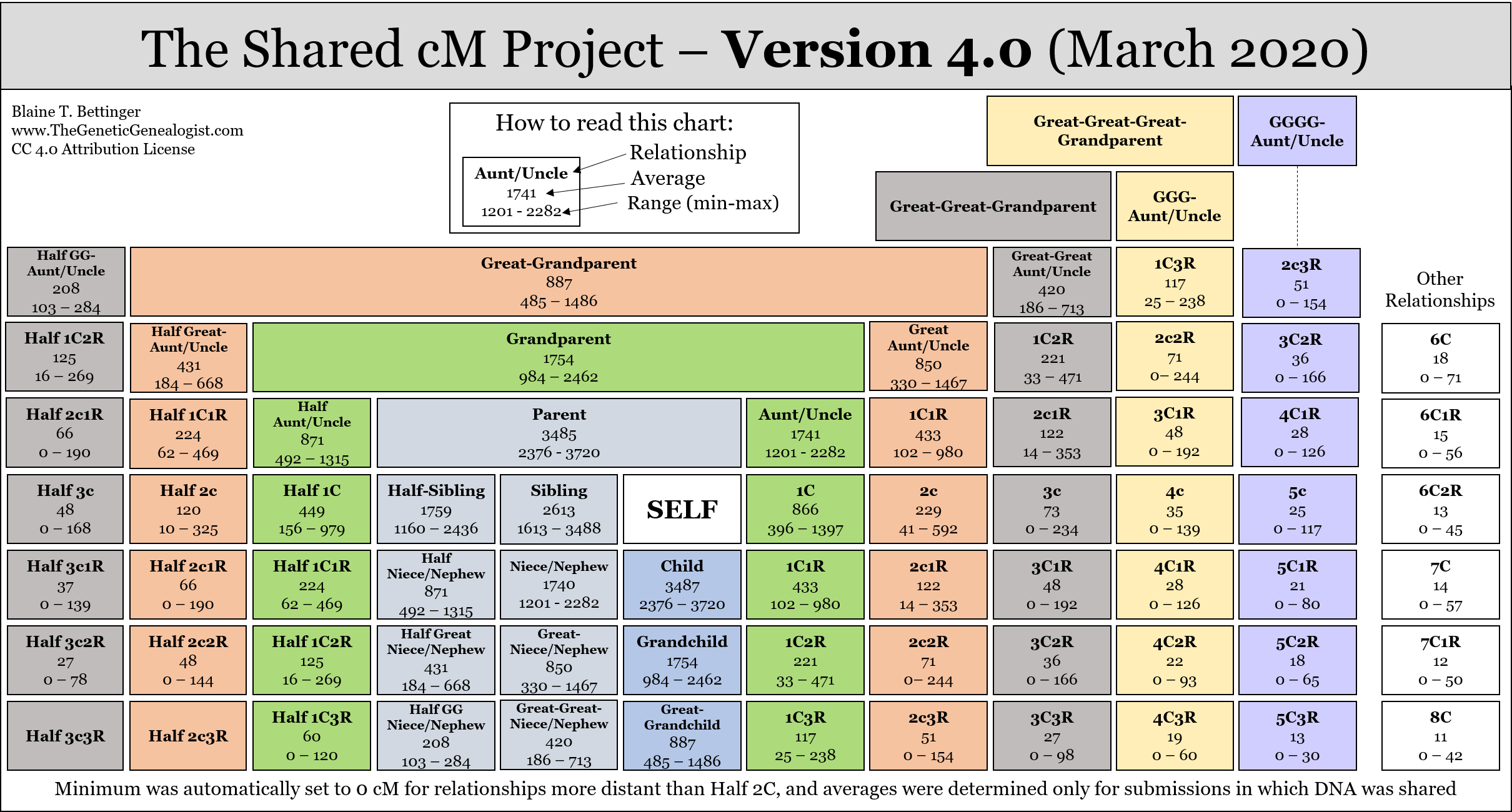

This chart shows what the actual reported amounts of DNA are for various relationship. So, for example, the ISOGG first chart shows that first cousins share on average 850cM of DNA. Bettinger's chart shows us that for first cousins (green box labeled 1C next to the central SELF box) companies are actually measuring an average of 866cM. But look at 5th cousins. ISOGG/theory tells us to expect about 3.3cM shared DNA. Bettinger reports that 5th cousins are reported, on average, as sharing 25cM, about 8 times what is expected. This is probably in large part because if the average is 3.3cM, but there is lots of variability above and below this, and everything below about 7cM (twice the expected average) is not considered, the reported average number will be much higher than the expected average. It is also likely for distant relationships that there are multiple relationships, each contributing some DNA, some of which the DNA matches don't know about.

So does this table help determine my Patchen relationships? According to this Shared cM Project table, 6th and 8th cousins are reporting, on average, 18cM and 11cM shared DNA, respectively. This chart says it's more likely that my Connecticut Patchen matches, all of which share 8cM with me, are 8th cousins. But if our Lemuels are the same person, which I think is true, two of these matches are known to be 6th cousins. How can that be? Take another look at the above chart. For 6th cousins, the range reported was 0 (in other words, not detected as a match at all) to 71cM shared. For 8th cousins, it was 0 to 42cM shared. So my 8cM matches could be in either one of these ranges. There are other numbers from the Shared cM Project (standard deviations) that I can use to nudge my opinion about these relationships, but while I can be confident that we are related, I can't identify the exact relationship.

That's a lot of work and explanation for a shoulder shrug, but it demonstrates limitations of autosomal DNA testing, especially for distant cousins, it showed how some useful tables and charts can be used in testing a relationship hypothesis, and it does show some evidence that our Lemuels are the same.

Friday, May 29, 2020

AncestryDNA has won me over

If you've seen my other posts, I am not, in general, a fan of Ancestry.com . It's complicated. But recently I submitted DNA to Ancestry and currently am thrilled with some of its features.

 Like Don't Like Same as other matching services
 Lots of potential matches Specific chromosome information hidden Many matches don't respond to queries
 5 generation trees (for those who have created them)
List of surnames through 10 generations
Difficult to export match information for analysis or tracking in third party software
 Common Ancestors (if you have submitted a tree, may show relationship between you and match, possibly passing through several other trees) Lots of hooks to get me to subscribe to their (I think) expensive records service
Many shareable family trees Must be a subscriber to easily view trees, pictures, documents, etc.
 Easy to set me up to manage DNA kits submitted by others


I do recognize that the items I "Don't Like" are features that make sense from Ancestry's point of view, usually protecting privacy of members' data, and allowing Ancestry to build a "gated community" that requires paid access, and to generate the revenue they need for their enormous infrastructure and stores of genealogy records. As a long time genealogy researcher who has seen the disappearance of public, collaborative research, I can still "Don't Like" them.

Thursday, May 28, 2020

A New LaBrune!

I've recently been in touch with a DNA match, seemingly through my LaBrune ancestors. I quickly was convinced that she is a descendant of one of my immigrant LaBrune family who disappeared. Here's why:

My Rationale for Adding Margaret to My LaBrune Family
My LaBrune family New LaBrune Explanation
?nne M. LaBrune (partially readable name on ship's passenger list)Margaret LaBruneM. could stand for Margaret
?nne M. was 14 years old when ship arrived in 1833Margaret was born in ca. 1820Ages are within a year of each other
LaBrunes were living in Clermont county, Ohio in 1840, but without ?nne M.Married Margaret LaBrune Chauvet and her husband were living in Clermont county, Ohio in 1840They lived near each other in 1840
LaBrunes moved to Dubuque in 1840sChauvets moved to Dubuque in 1840sBoth families moved to Dubuque in 1840s
Shared DNA with ten 4th cousin once removed descendants of George LaBrune ranges from 10cM to 29cM, with a median of 17cM (Ancestry can identify about 1/2 of DNA matches for this relationship, and my DNA tools may not be capturing all data below 10cM, so my median will be higher than the theoretical average of 7cM)Shared DNA with 4th cousin once removed descendant of Margaret LaBrune is 11cMShared DNA is within range of my similar cousins

Here's my preliminary Family Group Sheet for Margaret's family. I'm still looking for information and some of this information may change. But here's what I have so far:

Family Group Record for Adolph Baptiste Chauvet

================================================================================
Husband: Adolph Baptiste Chauvet
================================================================================
           AKA: Cauvett, Schauvett
          Born: 16 Oct 1816 - Montpellier, Departement de l'Hérault,
                 Languedoc-Roussillon, France
          Died: 19 Jul 1895 - Dakota City, Humboldt co., Iowa
        Buried:  - Humboldt, Humboldt co., Iowa
      Marriage: bet 1837 and ca 1845            Place: Cincinatti, , Ohio
================================================================================
   Wife: Jeanne? M. "Margaret" LaBrune
================================================================================
          Born: 1820 - , , , France
          Died: 4 May 1864 - North Buena Vista, Clayton co., Iowa
        Buried:  - Holy Cross [Dubuque], IA
        Father: Philippe LaBrune (1794-Bet 1880/1887)
        Mother: Ann Rayne (1793-1868)
================================================================================
Children
================================================================================
1  F  Mary L. Chauvet
          Born: 23 Oct 1840 - Cincinatti, Hamilton, Ohio
          Died: 6 Nov 1918 - Kansas City, Jackson co., Missouri
        Buried:  - Kansas City, Jackson co., Missouri
        Spouse: Christopher Kalen (1838-1905)
    Marr. Date:
--------------------------------------------------------------------------------
2  F  Margaret L. Chauvet
          Born: 24 Dec 1843 - Dubuque, Dubuque co., Iowa
          Died: 2 Jun 1909 - Dakota City, Humboldt co., Iowa
Cause of Death: nervous prostration and heart failure
        Buried:  - Humboldt, Humboldt co., Iowa
        Spouse: Albert M. Adams (          -          )
    Marr. Date: 9 Dec 1876
        Spouse: Absalom Little (          -Abt 1863)
    Marr. Date: Abt 1859
--------------------------------------------------------------------------------
3  M  Adolphus B. Chauvet
          Born: 1852 - , Dubuque co., Iowa
          Died: 17 Jan 1890 - Fort Dodge, , Iowa
Cause of Death: inflamation of the bowels
        Buried: 18 Jan 1890 - Fort Dodge, , Iowa
        Spouse: Sarah J. [Chauvet] (1856-          )
    Marr. Date:
--------------------------------------------------------------------------------
4  M  William Louis Chauvet
          Born: 15 Jan 1857 - , Clayton co., Iowa
          Died: 5 Jun 1940 - Los Angeles, Los Angeles co., California
        Buried: 7 Jun 1940
        Spouse: Millie [Chauvet] (          -          )
    Marr. Date:
--------------------------------------------------------------------------------

Wednesday, May 27, 2020

Hawes Family History

A DNA link led to some genealogy research and a connection to the well-researched Hawes family history book, The Edward Hawes Heirs: Edward Hawes, ca. 1616-1687, of Dedham, Massachusetts, and his wife, Eliony Lumber, and some of their descendants through eleven generations, compiled by Raymond Gordon Hawes and published in 1996, and a supplement published in 2002. An excellent genealogy work. I've posted a family history of our Hawes family on my web site: go to http://cushings.com/roots/ , and select Hawes from the list on the left.