Friday, July 15, 2022

Illinois Henneberrys

Many years ago I exchanged some e-mails with Ron Knowles, who had created a web site presenting his research on a Henneberry (one spelling variation) family from the Glen of Aherlow. The immigrant ancestors were David and Jane Cushing Henneberry, who settled in Will county, Illinois. At the time it seemed that we had little evidence of a possible connection between our families except for the Cushing name and that both the Henneberrys and our immigrant Cushing ancestors, Dennis Cushing and Catherine Casey, were married in Galbally, County Limerick, Ireland. Our exchanges must have been more than twenty years ago.

In the interim, I've been searching for Dennis' Cushing family in Ireland. And after 25 years, I have not found one. At least not one that is definitive and informative enough that I can attach a list of names of siblings and parents. Also in the interim, I've come to see that Cushing (or it's Irish spellings, Cushen at the time) was not a very common name and that they were nearly all located approximately in the triangle formed by the cities of Limerick, Tipperary and Cork. So two Cushings near Galbally were likely related, but determining the relationship, due to sparsity of records, is difficult.

In 2018 I reluctantly began submitting DNA samples for genealogy research. I say reluctantly because for years I had had misgivings about making my DNA public and opening up myself and anyone to whom I am related to abusive and discriminatory uses that will develop in the future that we can only imagine. I'm still not completely comfortable that submitting and revealing my DNA was wise. But without going into all my philosophical pros and cons, not the point of this article, I'll just say that this is where I am in my genealogy journey.

I've just been searching through ancestry.com family trees, a snippet of which is made available to me for having used their DNA analysis service, and came across Jane Cushing Henneberry. This is just one connection, and so far I don't know if this branch of the 32 branches visible to me is the source of the shared DNA. Nonetheless, this is an important connection to consider. I'll be searching for more such connections. In the meantime, I've been searching for the link on my web site to the Henneberry site, and can't find one. I'm sure there used to be one, but it must have been lost in the major revision I made several years ago. So I'll be adding a link and an explanation soon.

My memory is that the Henneberry and related Magner family groups were separate but both held information on the Henneberrys. It now looks to me like both sites are/were managed by Ron Knowles, but that neither has been updated since 2008. My attempt to reach Ron a few years ago did not get a response, so the pages may no longer be active. I should probably archive the Cushing related pages in case they disappear. But here are links to the primary Henneberry site and to the related Magner site.

Henneberry web site: http://www.henneberry.org/

    Cushing page on site: http://www.henneberry.org/trees/cushing.htm

Magner site: http://www.magner.org/ 

    This site doesn't have as much Cushing information, but does have some photos and descriptive information of the Glen of Aherlow area.

Thursday, February 11, 2021

GDAT: Genealogical Data Analysis Tool

DNA analysis for genealogy research is not easy. Most people are content having likely relatives identified for them, recognizing a few, recognizing some related family names. Some of the DNA services can suggest helpful records from their vast catalog. If you've created a family tree, some services can connect you to other family trees that might identify your common ancestor. Some identify triangulations, or let you compare graphical representations of DNA segments. All of this is helpful.

But these services have two major shortcomings. First, they are competing for massive numbers of paying customers and focus their development on making analysis both easy and proprietary. They do massive amounts of data analysis and present you with the result, or a simple tool. But they do not offer tools that allow you to do lots of your own analysis. Perhaps there just isn't a large enough market for sophisticated analysis. The second shortcoming is that they can only compare data of their own customers.

GMP and GDAT

For the past year and a half, I've been using a third party tool, Genome Mate Pro (GMP), to do some of this analysis. With some supporting third party tools, like Pedigree Thief, 529andYou, DNAGedcom, and perhaps others, which gather ICW, triangulation, and family tree data that is not available for export from any of the genealogy DNA services, GMP assembles DNA match data from all of these services - AncestryDNA, MyHeritage DNA, FTDNA, 23andMe, and GEDMatch (doesn't test, but does have DNA matching data) - into a single database. GMP has just been replaced by GDAT (Genealogical Data Analysis Tool) to facilitate continued future development. Unfortunately, not all of the information you would like to gather is available: Ancestry has threatened third party software developers with legal action if they gather match and tree information from their site, Ancestry does not show detailed chromosome data for matches, and Ancestry does not make available for export/sharing/harvesting match or chromosome data, like the other services do.

GDAT Analysis

Once your imported all available data into GDAT, you can:
(1) Easily view your DNA matches from all the different testing services that you've imported. In this list you can see the status (MRCA identified? sent e-mail? plus many more), the ancestor branch of the family they belong to (if you've identified one), any helpful note you've added, how much DNA you share, whether or not you've added their tree, and more.
(2) Easily change to detailed views of more information gathered about your match: which DNA segments they share, lists of ICW or triangulations that you share, their family tree, family surnames and locations, contact information, and more.
(3) Easily view graphical representation of shared DNA segments, along with others in your database that have nearby or identical segments. You can declutter these views by setting minimum cM required for display.
(4) From any of these lists you can run a comparison on any available family trees to identify common family names.
(5) You can assign DNA segments shared with a match to your common ancestor (MRCA).
(6) You can add extensive notes with more information, records gathered to created a (match's) family tree, status of your research, stumbling blocks, etc.
(7) You can merge matches. Why? If you have two matches who are a parent and a child, usually the DNA you share with the child is contained within the DNA you share with the parent. Usually, the parent shares more DNA, or is a "better" match, and is closer to you in the family tree you eventually hope build that includes both of you. The child's DNA does not provide any information that you don't get from the parent, so you may wish to declutter your lists by eliminating the child's information. If you delete the information, though, it will be added as a new match the next time you import an update on your DNA matches. Merging the two will prevent the less important match from reappearing. You may also find that one of your matches has been tested at two or more different services, so appears three times among your matches. You can declutter your lists by merging this relative's three records together.

There are other tools and features, and I expect that more will be added with future releases of GDAT. (With GMP, an update was released about once per month.)

GDAT organizing

Perhaps more important than the analysis tools, though, is the ability to keep track of your research. You can make extensive notes, on multiple pages, if you like. You can copy and paste records, correspondence, to do lists, etc. Notes, status flags, and ancestor branches, across several DNA testing sources, have helped advance my research more than the promising analytical tools, so far.

I don't want to give the impression that this tool leads to easily extending your ancestry. It is a lot of work. In three years, though I've identified hundreds of DNA matches, I only count a half dozen major discoveries. And I don't think any of them was due to a GMP analysis tool. But all were helped by being able to keep my research organized with GMP.

Conclusion

So if you're interested in putting in the work needed to extend your family tree through DNA research, I highly recommend adding GDAT to your toolbox. (Note1: I also highly recommend making a donation to the developer. Note2: Be warned: there is steep learning curve for GDAT. Not like learning a new programming language, but much more than, say, learning to use e-mail.)

Wednesday, January 6, 2021

23andMe

As I continue to research my ancestry through DNA, using various tools and services, and gaining experience and perspective, my views of DNA services evolve. These are my thoughts about 23andMe at this time, nearly three years into my DNA research.

Pros:

(1) The biggest advantage from 23andMe is that they provide DNA-related health and trait reports, both interesting and potentially important. (23andMe is not authorized to provide medical information, but a 23andMe report would certainly be a good basis for seeking medical advice from your doctor.) They offer different analysis products, and I believe the least expensive does not include health reports, so make sure to order the level of analysis you want.

(2) 23andMe has a large number of DNA contributors. I have found many known relatives there and have identified many matches. Though my already well-developed family tree has made that easier, perhaps, than for others.

(3) 23andMe provides a list of DNA matches in common (ICW), as do the other services. They also indicate which of your common matches "triangulate", a much higher level of confidence that a match is related. On the ICW list are shown, too, the relationship of your principal match to you and to the ICW. (MyHeritage does this; Ancestry and GEDMatch do not.) Sometimes it is necessary to construct trees for your matches, a slow, labor-intensive process, and information about how some ICW are related to each other can help enormously in focusing on fewer possible branches.

(4) 23andMe uses a prominently displayed star next to each match in your primary list of DNA matches, that you can toggle on or off. This is very helpful for showing which matches you have placed in your tree. (Browsing through matches for matches to work on next, it's very helpful to easily see those already completed.)

(5) Ethnicity estimates seem as accurate as any, at least for my very homogenous ancestry. I think my best estimates come from my own family tree.

(6) 23andMe analysis includes the X-chromosome, which others do not. Since males inherit X chromosomes only from their mothers, a match on this chromosome can make tree research easier by eliminating some lines of ancestry. This has not led to identifying a match for me yet, but it is one more analysis tool.

(7) While they do not provide a detailed analysis of the Y-chromosome, they do identify a paternal haplogroup for males, which is a pattern found on this chromosome. Theoretically, this could be another tool to help connect to male relatives. In practice, I find it confusing because some haplogroups are closely related and a father and son may be identified with different haplogroups. If you know enough about haplogroups to recognize those that are closely related, perhaps this is not a problem. So I list this as a pro because it could be a useful tool, even though not yet for me.

(8) 23andMe has so far tolerated the use of third party tools, like 529andYou, to help gather DNA match information. (529andYou gathers lists of triangulations.) Though recently there has been more use of Captcha to, I assume, distinguish between people using data collection tools and robots.

(9) Though the lack of tree building is listed as a con below, the associated pro is that the user profile allows you to list birthplaces of your grandparents and family surnames and a link to a tree located elsewhere. This is enough information, often, to start a tree that can be continued by finding grandparents in census records (currently born before 1940).

(10) 23andMe allows you to download files for your raw DNA analysis, your matches and your shared DNA, which can be used for your own analysis offline.

(11) 23andMe seems to show matches down to about 7cM. (The bigger limitation is, perhaps, the number of matches displayed. I believe that MyHeritage and 23andMe limit the number of matches displayed, to about 8000 and 1000, respectively. When you have long-time American families, like my Dad's ancestry, these limits are reached before you reach the lower shared DNA threshhold, so there are not many matches shown below about 8cM. Ancestry's limit is, rather, the lower DNA match threshold, which they recently raised from 6cM to 8cM. All of these limitations are to avoid overwhelming [most] users with matches well beyond their interest and to reduce the load on their servers). So this could be a pro or a con.

Cons:

(1) 23andMe is not a genealogy service. There is no sister company with historical records, there is no family tree building feature. As part of your descriptive profile, you can list family surnames, your grandparents' birthplaces, and a link to your family tree. Personally, I don't need the paid access to historical records and have a public family tree with a link, so don't find this "con" a disadvantage. However, the lack of trees does make research quite a bit more difficult and I find my self searching for relatives more often on Ancestry and MyHeritage because of this.

(2) Managing or researching others' DNA can cause confusion. I have access to some DNA tests. Because I don't want to be seen as impersonating someone, when I send a message to a DNA match I explain that I am not their DNA match and what my relationship is to their match. Then I send a message, but since it's not my account I'm not sure how the message sender is shown. I usually include an outside e-mail address to make communication less cumbersome. Ancestry makes it easy to assign a management role to me. (Though I'm not sure how clearly communications are identified with them, either.)

Overall, I generally recommend this service, especially if you would like to get DNA-related health and trait reports.

MyHeritage.com

As I continue to research my ancestry through DNA, using various tools and services, and gaining experience and perspective, my views of DNA services evolve. These are my thoughts about MyHeritageDNA, at this time, nearly three years into my DNA research. (Note: though I use the name MyHeritageDNA to distinguish the DNA matching service from the record searching service, both are accessed through the address myheritage.com, and the services are closely linked.) (Another note: MyHeritage is an Israeli company.)

Pros:

1) MyHeritageDNA has a large number of DNA contributors. Even though they are relative (no pun intended) newcomers to DNA analysis, they have allowed people to submit DNA analysis files from other services in order to quickly grow their contributors.

2) MyHeritage allows contributors to build family trees linked to their DNA, essential for exploring your relationship. While trees are generally smaller than what is available at Ancestry, in most cases you have full access to the whole tree. (Ancestry limits access to 5 generations, 23andMe doesn't have trees, GEDMatch does allow trees, though I find few contributors have them.) 

3) MyHeritage (currently) allows the use of third party tools that gather family tree data and DNA match data for exploration offline.

4) MyHeritage's list of common matches (ICW) also shows the relationship between the match and the ICW. This can be helpful in focussing your search for a relationship, or for selecting closer relationships to investigate. (For instance if you know that one of your ICW is a great aunt to the match you're reviewing, you can limit your investigation to the great-aunt's ancestor tree.)

5) MyHeritage has a closely linked (for pay) records collection, though I have never used it and can't comment on how it compares to other records services.

6) MyHeritage also owns one of the premier genealogy products, Legacy Family Tree, which is my genealogy software. While I know that Legacy has features that facilitate genealogy research, I don't use these features myself.

7) MyHeritage allows you to download your DNA analysis file, as well as match files. The former allows users to submit their DNA analysis to matching services like GEDMatch (I'm not necessarily recommending you do that). The latter allows users to keep track of DNA research offline using, for example, tools like Genome Mate Pro.

8) MyHeritage shows detailed information on shared DNA segments and which matches "triangulate", a much higher level of confidence of a family connection than the ICW relationships. (Ancestry shows only ICW. 23andMe shows both ICW and triangulation. GEDMatch shows only ICW, though I'm not sure what they offer to paid subscribers.)

9) Has an interesting DNA research tool:. DNA Clusters shows groups of related DNA matches. It used only about 100 of the several thousand matches, but as I identify more of my matches it is showing some promise.

10) MyHeritage ethnicity estimates seem as accurate as those from other services. At least compared to my own family history estimates.

Cons:

1) MyHeritage shows matches down to 8cM. Ancestry recently raised their minimum to 8cM as well. 23andMe seems to show down to about 7cM. For those, like me, with well-developed family trees, smaller amounts of shared DNA are needed to extend our histories. Smaller DNA matches are admittedly much less certain, but I have made several 6cM matches (at Ancestry before they changed their minimum match criterion) so far and would prefer to have access to these possible more distant matches.

2) MyHeritage flags are not very useful. I can neither set a flag (or star, as in Ancestry or 23andMe) nor read an annotation (as in Ancestry) to indicate that I have already connected a match to my family. In MyHeritage I have to open the attached note to know the status of this match.

3) For whatever reasons, I have identified far fewer matches through MyHeritage than through 23andMe or Ancestry. I assume this is mostly the relative popularity of this service.

Tuesday, January 5, 2021

Donnellys from the Irish Free State

 The information isn't new, but the realization is. The death certificate of Nellie Donnelly, daughter of James Donnelly and Mary Buchannan, says her father was born in the Irish Free State. James was the oldest son of Patrick Donley/Donnelly and Ann Larkin. While the Donnelly name was most commonly found in counties Armagh and Tyrone, Larkins were more likely in Tipperary. Donnelly is such a common name, that I haven't even searched for the family in Ireland. Since it seems just about every surname could be found in Dublin, I've wondered if the family might be from there. If the death certificate information is accurate, it at least moves me away from continuing to consider Northern Ireland as our Donnelly origin. At least, after the Donnelly-Larkin marriage.

Sunday, December 20, 2020

AncestryDNA

As I continue to research my ancestry through DNA, using various tools and services, and gaining experience and perspective, my views of DNA services evolve. These are my thoughts about AncestryDNA at this time, nearly three years into my DNA research. (Note: though I use the name AncestryDNA to distinguish the DNA matching service from the record searching service, both are accessed through the address ancestry.com, and the services are closely linked. AncestryDNA clients get many notifications of digitized records and family trees available with paid subscriptions to the Ancestry.com historical records service.)

Pros:

(1) AncestryDNA has a large number of DNA contributors, so a large opportunity for connecting with cousins whose common ancestry could help extend your own known ancestry. I have found, though, that Ancestry has more "closer" connections in some of my ancestor branches and fewer in other branches, compared to DNA matches in other DNA services.

(2) AncestryDNA, through its sister genealogy research service, Ancestry.com, has access to family trees for many of its DNA customers. AncestryDNA furnishes a five generation summary tree (just names and lifespan years, organized in a tree) for those matches who have posted a tree and allow it to be "public". For those trees that are not public, it is easy to request viewing privileges. I find that about half will not grant privileges (protecting privacy) and half will (collaborating on research). Also, once you are granted access, AncestryDNA conveniently keeps all trees to which you have access in a convenient tree drop-down list.

(3) AncestryDNA provides a list of DNA matches in common (ICW), though more limited than other services.

(4) You may post a limited tree and link it to your DNA so that others may search for family connections. (Available to AncestryDNA customers, though I don't know if it is available to other Ancestry.com subscribers who are not DNA matches.) After a certain size, a fee is charged for hosting the tree.

(5) If you choose to post a family tree, AncestryDNA has two related analysis features that help identify common ancestors: ThruLines and Common Ancestor. These tools basically compare your tree to those of your DNA matches and shows you how you are related, sometimes piecing together parts of several different trees to create the path. Even though these tools don't generally show me the ancestries I'm most interested in, they do identify which ancestor branch the DNA match belongs to, and allows me to focus my work on those (usually different) branches that are of most interest to me. The most useful result from these tools, so far, has been confirming a relationship between my Patchens and an old, well-researched Patchen family, and introducing relatives in a recently discovered ancestor so that I have found distant cousins that will help add a new branch of descendants to my tree, if I decide to pursue that. (I'm much less interested in finding cousins, aka other descendants of common ancestors, than I am in discovering new ancestors.)

(6) AncestryDNA is available independent of Ancestry.com . I initially stayed away from AncestryDNA because ... well, originally because I have strong reservations about posting DNA in public places. But in addition to that, I assumed that in order to have access to DNA matches, I would have to subscribe to the ancestry.com service which, as a long time researcher, I find expensive and of very limited use. This is not the case. A DNA analysis costs about $100 (often on sale for about $60?) and this includes access to the DNA matching for as long as you leave your DNA hosted on the AncestryDNA service.

(7) AncestryDNA provides very easy granting of privileges for sharing your DNA information. For example, though some of my DNA analyses were done by others, they have been able to easily grant me a management role, allowing me to research and annotate DNA matches, and post related family tree data.

(8) The annotation features are better than for other services. You can assign a prominent star for relationships established and color coded dots for various branches of your family, and it's up to you to decide how you want to use the star and dots. You can also attach a note, say a detail of how your related, or a suspected branch. All of this is visible in search results, making it very valuable for keeping track of your research.

(9) AncestryDNA has probably more experience than most  in estimating ethnicity (geographic origins) from DNA. Their estimates are fairly detailed. I would say, however, that our ancestry is fairly homogeneous (predominantly Irish and English, completely western European) and it is very difficult to isolate geographic origins from DNA. So I think their estimates are pretty good, but should be viewed as approximate. I attribute better accuracy to my genealogy research. From time to time, they change their estimates as they tweak their algorithm.

(10) You can indicate in a profile your research interests, outside links, languages spoken, etc. This is useful for giving a link to a family tree located outside of Ancestry.com .

Cons:

(1) Unlike the other services I've used (so far GEDMatch, 23andMe, MyHeritage), AncestryDNA does not allow you to download your match information. (They do allow you to download the DNA analysis.) So if you wish to perform some DNA analysis outside of AncestryDNA that involves matches, you must hand transcribe each match. Some data "harvesters" have been developed to make this transcription and analysis, and research management, easier, but Ancestry recently threatened them with legal action and they have abandoned their support of Ancestry data. (Harvester can no longer facilitate the painstaking transcription of family trees, for comparison with those of other matches, either.)

(2) Unlike the other services I've used, AncestryDNA does not show details of DNA segments that you share with your DNA matches. Since these segments are inherited, their identity can help identify your common ancestry.

(3) AncestryDNA does not identify "triangulations", only "ICW". (ICW is a list of matches you have In Common With one of your matches. In other words, ICW is the intersection of your list of matches and the list of matches of one of your DNA matches.) Triangulation is stronger proof of a common ancestor than is ICW.

(4) If your family tree already goes back several generations, like mine, the five generation tree shown by AncestryDNA is inadequate for finding a common connection. [To get deeper access, there are two options: (a) subscribe to Ancestry.com, or (b) try to find the matches full tree through your library's access (during Covid shutdowns, may be available from your home computer).]

(5) Searches results among DNA matches and your list of ICW are limited to matches sharing 20cM or more of DNA. Fourth cousins share on average about 13cM, so the AncestryDNA limits your searches to those more closely related than fourth cousins, or to common ancestors back only four generations. If you have a well-researched tree, you probably know history back to your immigrant ancestors, in my case four or more generations. AncestryDNA makes it more difficult to research more distant ancestors, a severe limitation.

(6) AncestryDNA does allow you to view matches down to 8cM in your unfiltered, unsearched, list of DNA matches. Other services allow down to 6cM. I've made several connections with 6cM shared DNA. On AncestryDNA, actually. It was just recently that they raised their lower limit to 8cM.

(7) Messaging, especially if you are managing someone else's DNA, is "clunky". Since I'm not a subscriber to ancestry.com, I frequently get messages that I must join to send messages. However, if you click in other places, you are allowed to send a message. If I'm managing someone else's DNA,  I don't think the DNA match I am writing about is shown in my message, so I'm careful to describe how I am related to the DNA, and why I may be requesting access to a family tree. Also, when I try to find messages already sent, I find it difficult to find what I'm looking for, often resorting to scrolling through all sent messages until I find what I'm looking for. With MyHeritage and 23andMe, when I click on a message button, I'm shown the thread of previous communications. As with other services, I usually include an outside e-mail address because that is more usually more convenient, especially if you wish to share documents or communicate with more than one person at a time.

Overall, I generally recommend this service, especially if you are not trying to extend an already well-developed ancestry, or relying on outside tools to analyze and keep track of your research from multiple services.

Book: The Killer Angels by Michael Shaara

The Killer Angels book coverIt's been a few years since I read this book. The Killer Angels is a book of historical fiction, published in 1974 by Michael Shaara. As I've explained elsewhere, I find non-fiction difficult to read, and appreciate well-researched historical novels that give historical context to some of my ancestors.

Shaara's novel follows General Robert E. Lee and several of his staff of officers from June 29, 1863 to July 3, i.e. through just the days of the Civil War. Shaara draws heavily on statements and communications from the officers and combatants to make the account more personal and present, giving the reader the feeling of witnessing the events as they take place, but also the personal struggles of those who participated. While there are many in our family tree who fought in the Civil War, almost all on the Union side, my own Donnelly ancestor is known to have fought with the 60th Regiment of New York Volunteers at Culp's Hill, and I was fascinated and proud to learn about the key role that battle played in the eventual outcome of the larger Battle of Gettysburg and the War itself.

I thoroughly enjoyed the book and highly recommend it.


GEDMatch

For years, I avoided GEDMatch, fearing as-yet-unknown risks of publicly posting DNA. Recently, having discovered that close relatives had already posted their DNA on other DNA matching sites, I decided to try GEDMatch. Here are my first impressions.

Cons:
(1) I found no first cousin or closer relatives on GEDMatch, making my DNA a sole source for identifying close relatives. I may have my DNA deleted from this service.

(2) Because there are no close relatives among my matches, it is exceedingly difficult to identify any matches.

(3) Gathering match segment data, needed to determine common segments between matches, is tedious using the free version of the service. This information must be gathered individually for each match. There is a paid version of the service, and I don't know if gathering segment is any easier with it.

(4) For now, as a newbie to GEDMatch, I'm concerned about determination of amount of shared DNA. Often, a cM amount that is given in the list of matches does not correspond to the sum of the segments. Often, when I find that the same individual is listed on a different DNA analysis service, the amounts of DNA shown by the two services is significantly different.

(5) The ethnicity estimating tools are much less precise, geographically, than available at other services.

(6) There is no ability, at least in the free version, to annotate or tag matches as you identify them, something available in the other services.

Pros

(1) It's free.

(2) Using the free version of the service, it is easy to gather a list of matches, a list of common matches, and a family tree (if available). Note that I use Pedigree Thief (a Chrome extension) and Genome Mate Pro to harvest information and keep track of my research. 

(3) Email addresses are available for each match. (Though I have not tried any, so don't know to what extent they are valid.)

(4) There are many matches at GEDMatch that I don't find on the other services that I use. However, since I'm having trouble identifying these matches, this may not be useful.

(5) You can upload your DNA file from any testing service. Ancestry and 23andMe do not allow this. MyHeritage does allow this, though I'm not sure what limitations they currently impose on free uploaded DNA data vs. DNA analyzed at MyHeritage. 

At this point, I would not recommend GEDMatch unless you are an advanced DNA user with an extensive tree and many DNA matches identified with other services. (It's possible that the lack of close matches is an anomaly for my DNA and others would benefit more. I have no knowledge of this, yet.)

Book: The Dublin Saga by Edward Rutherfurd

The Princes of IrelandEdward Rutherfurd wrote a pair of historical fiction novels called The Dublin Saga: The Princes of Ireland (2004) and The Rebels of Ireland (2006). I don't generally enjoy non-fiction, so these types of books are my way of learning some history and, more enjoyably, getting an historical setting for people and places in my family history.

The Princes of Ireland begins with mythical peoples and progresses through the druids, Christianity, the Vikings, conquest by England and subsequent centuries of rule. The Rebels of Ireland continues from about 1600 with the powerful animosity between Catholics and Protestants, the constant back and forth between British rule and Irish independence, takes us through the horrible Great Famine, the schism between Ulster and Catholic Ireland, rebellions, the rise of Sinn Fein, and through the partition of Ireland. I found especially interesting the intertwining of the American Revolution, relationships with France, massive emigration to America, which were occurring in about the same time period as the emigration of our Irish and French ancestors to America. The descriptions of the religious animosities between Catholics, Protestants, and Puritans added context even to the earlier emigration of Puritans to the New World, also part of our family history.

Though the saga is principally located in and around Dublin, the famine takes place mostly in Ennis, in west Ireland, and some of the stories include other counties. In Princes, Rutherfurd explains origins of many place names and families. Written very recently, he explains that the historical context that he portrays includes the current understanding of Irish history. I enjoyed these books immensely.

Sunday, August 2, 2020

New Family Tree

I've finally gotten a family tree back online! This time it's located on my own genealogy web site at https://cushings.com/roots/public_tng/ .  (Also in the list of links to the right.) A few things are different. I've used a php package called The Next Generation (TNG). It took a few days to get it installed, and another few days to test it's features, privacy, security, and whatnot to make sure it met my needs. The advantages over my previous Rootsweb installation are that it is online (Rootsweb trees went offline for about a year), it allows researchers to contact me (the new Rootsweb had no attribution or contact for the tree owners), and the search and display and look and feel of the web site is so much better than what Rootsweb offers (or at least what it was offering when I finally removed my tree about a year ago). The advantage over an Ancestry tree is that I can make this available to the public. (You have to be an Ancestry subscriber to see Ancestry trees.) Other services offer tree space, but with a tree as large as mine I either needed to pay for space or allow others to collaborate on my tree, or other features that I don't need. I've also changed what information I'm making available. I'm just including a skeleton tree of direct line ancestors to help me better focus on extending my own tree. By including just direct ancestors, I'm hoping to connect with people whose own trees meet mine at its oldest branches. At least that's the hope. We'll see.

If you search my tree and you don't see a family you're looking for, but you know I'm related because I've mentioned someone in a blog post, or on my genealogy web site, please contact me. I'm happy to look for and share more information.

Thursday, June 25, 2020

DNA Case Study: Lemuel Patchen and Limits of Autosomal DNA Testing

[Minor corrections made 31 August 2020.]

We've traced our Patchen ancestors back to a Lemuel Patchen in Ontario, Canada in 1820, and his son, Thomas. Thomas was born in Canada in about 1796. Other than one census record, there is no other information on this pair in Canada. Other Patchen researchers speculated that our Lemuel was the same who had abandoned his family in the early 1790s and headed into Canada. This Lemuel was part of the extensively researched Patchen family of Connecticut. I described the details several years ago in another blog post: http://ourfamilyforest.blogspot.com/2012/07/lemuel-patchen-1770-1850s.html .

Recently, I had my DNA analyzed at Ancestry.com, and have found several DNA matches to Patchen descendants. Four of them are descendants of Thomas and, since I have quite a bit of information on our Patchens, were easily placed in my family tree as 3rd and 4th cousins. Four others, though, seem to have genealogies connecting them to the Patchens of Connecticut. Two are descendants of Walter Lockwood Patchen, a brother of Lemuel Patchen, both sons of George Patchen, born in 1737 in Wilton, Connecticut.  If we are descended from this Lemuel, these DNA matches are 6th cousins of mine. Two others are descendants of Ann Patchen Morehouse who, according to the extensively researched genealogy, is the daughter of Jabez Patchen, a first cousin to George. This would make me an 8th cousin to these DNA matches. I will mention, though, that there are some who argue that Ann Morehouse was not the daughter of Jabez, that her father was actually George, father of Lemuel and Walter. So her descendants may actually be 6th cousins, also.

Can the DNA analysis tell me if our Lemuel is the son of George Patchen of the Connecticut Patchens?

To answer that, lets look at the numbers. All four of the Connecticut Patchens share 8cM of DNA with me, and all are estimated to be somewhere between  5th and 8th cousins. The good new is that 8cM (cM indicate how likely it is that DNA is inherited), while small, is not insignificant. So it is likely, especially with several matches, that we are related to the Connecticut Patchens. Is our Lemuel the son of George Patchen, who left to Canada? There are some useful charts that might help.

A good resource for using DNA for genealogy is the International Society of Genetic Genealogy (ISOGG). A table on their statistics wiki page (Average autosomal DNA shared by pairs of relatives) shows how many cM of DNA are expected to be shared for different relationships. There is a lot of variability in the amount of DNA inherited from a specific ancestor, so the numbers in this table are the expected average values. The last line of this table shows that 3.32cM, on average, will be shared by 5th cousins. If you read the whole page, or study the table, you'll see that the average is divided in half for each additional generation of ancestor. For example, 4th cousins share 1/4 as much DNA as 3rd cousins. In the table 3rd cousins share 53cM of DNA, on average, and 4th cousins share about 13cM of DNA, about 1/4 as much. In this Patchen example, we're looking at 6th or 8th cousins, so take the last line of the table (5th cousins share on average 3.32cM of DNA) and divide repeatedly by four to see that sixth cousins share about 0.8cM, seventh cousins about 0.2cM, and eighth cousins about 0.05cM. Compare this to the measured 8cM DNA shared by me and my Connecticut Patchen matches. We share at least 10x more DNA than expected for the 6th or 8th cousin relationship I was considering. This implies we are much more closely related, but I know from our family trees (assuming they are accurate) that we are not more closely related.

When you study distant relationships, say more distant than 4th cousin (expected 13cM shared DNA), we run into a problem. Very small amounts of DNA may be the same between individuals, but not because it is inherited. They may be randomly the same. Some may be related to communities in which individuals lived. There may be errors in detecting. Or other reasons that I don't know about. But because very small segments that match may not be inherited from individual ancestors, and we can't know which are inherited and which are not, testing companies use a threshold when reporting shared DNA, usually 6 to 8cM. Because of this, when comparing distant relatives, many of the small dna segments are removed because they are below the threshold. In this case of 6th and 8th cousins, whose expected shared DNA is 0.8cM and 0.2cM, both well below the rejection threshold, we only see those relatives who are sharing much more than the average expected. There are two effects of this. First, most of the distant matches are below threshold so aren't even shown as matches. Second, those that do exceed the threshold are only those that share significantly more than the average, so the shared DNA will seem high. My Connecticut Patchen matches should share less than 1cM, but are measured as 8cM. So still can't tell what my relationship is to these Patchen matches. (But I'm pretty sure they are relatives.)

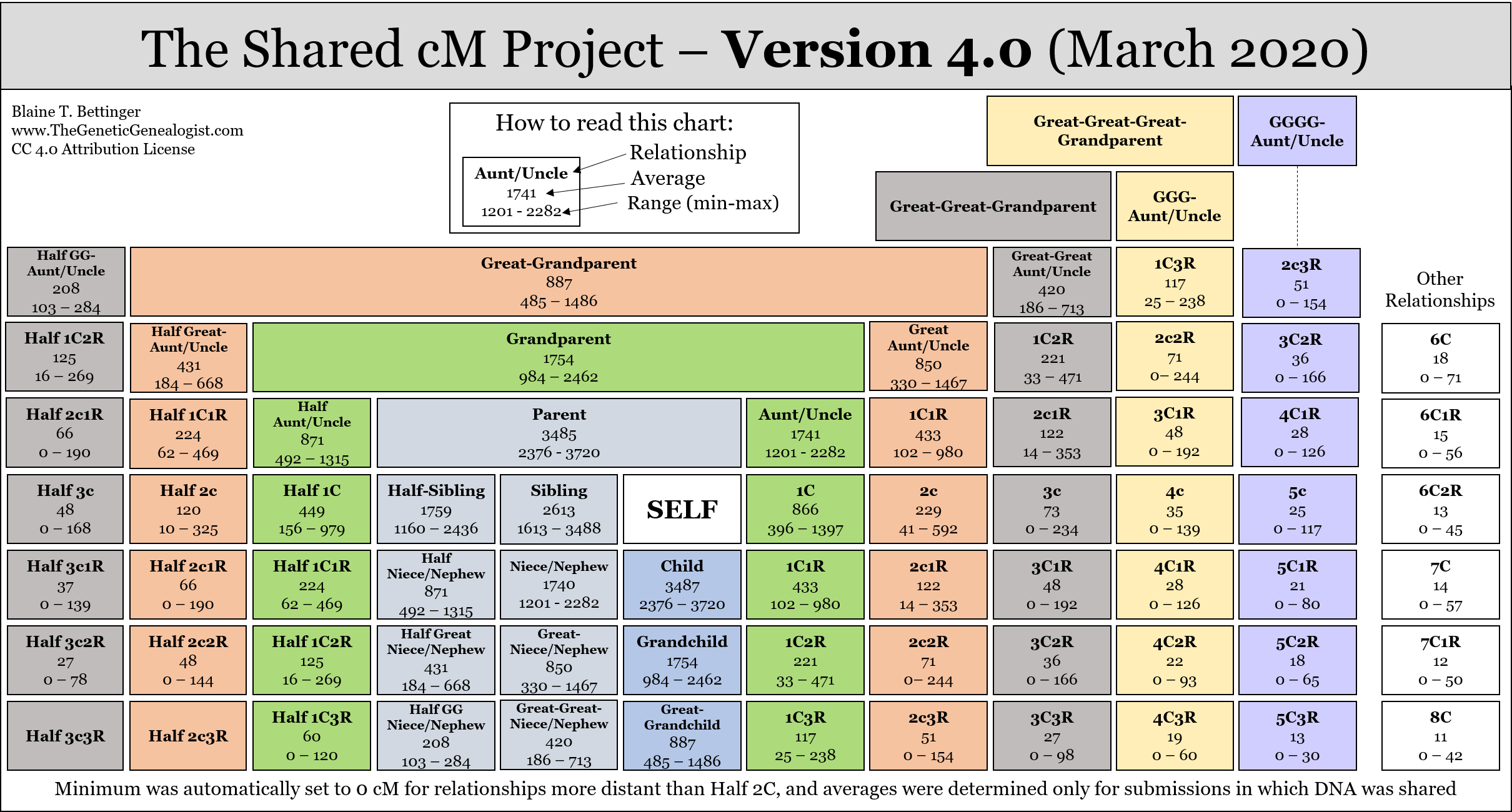
ISOGG's Cousin Statistics table shows the first effect. You can see that Ancestry can only detect about 11%  (about 1/10) of 6th cousins, and less than 1% (1 in 100!) of 8th cousins. The second effect is shown by the Shared cM Project of Dr. Blaine Bettinger, summarized in the table below. He gathers data from people who have DNA analyzed about their known relationships to DNA matches and the amount of DNA shared. The recent 2020 update summarizes over 60,000 data submissions. He generates a report that contains lots of useful charts, but the main one is this (click on it to make it bigger):


This chart shows what the actual reported amounts of DNA are for various relationship. So, for example, the ISOGG first chart shows that first cousins share on average 850cM of DNA. Bettinger's chart shows us that for first cousins (green box labeled 1C next to the central SELF box) companies are actually measuring an average of 866cM. But look at 5th cousins. ISOGG/theory tells us to expect about 3.3cM shared DNA. Bettinger reports that 5th cousins are reported, on average, as sharing 25cM, about 8 times what is expected. This is probably in large part because if the average is 3.3cM, but there is lots of variability above and below this, and everything below about 7cM (twice the expected average) is not considered, the reported average number will be much higher than the expected average. It is also likely for distant relationships that there are multiple relationships, each contributing some DNA, some of which the DNA matches don't know about.

So does this table help determine my Patchen relationships? According to this Shared cM Project table, 6th and 8th cousins are reporting, on average, 18cM and 11cM shared DNA, respectively. This chart says it's more likely that my Connecticut Patchen matches, all of which share 8cM with me, are 8th cousins. But if our Lemuels are the same person, which I think is true, two of these matches are known to be 6th cousins. How can that be? Take another look at the above chart. For 6th cousins, the range reported was 0 (in other words, not detected as a match at all) to 71cM shared. For 8th cousins, it was 0 to 42cM shared. So my 8cM matches could be in either one of these ranges. There are other numbers from the Shared cM Project (standard deviations) that I can use to nudge my opinion about these relationships, but while I can be confident that we are related, I can't identify the exact relationship.

That's a lot of work and explanation for a shoulder shrug, but it demonstrates limitations of autosomal DNA testing, especially for distant cousins, it showed how some useful tables and charts can be used in testing a relationship hypothesis, and it does show some evidence that our Lemuels are the same.

Friday, May 29, 2020

AncestryDNA has won me over

If you've seen my other posts, I am not, in general, a fan of Ancestry.com . It's complicated. But recently I submitted DNA to Ancestry and currently am thrilled with some of its features.

 Like Don't Like Same as other matching services
 Lots of potential matches Specific chromosome information hidden Many matches don't respond to queries
 5 generation trees (for those who have created them)
List of surnames through 10 generations
Difficult to export match information for analysis or tracking in third party software
 Common Ancestors (if you have submitted a tree, may show relationship between you and match, possibly passing through several other trees) Lots of hooks to get me to subscribe to their (I think) expensive records service
Many shareable family trees Must be a subscriber to easily view trees, pictures, documents, etc.
 Easy to set me up to manage DNA kits submitted by others


I do recognize that the items I "Don't Like" are features that make sense from Ancestry's point of view, usually protecting privacy of members' data, and allowing Ancestry to build a "gated community" that requires paid access, and to generate the revenue they need for their enormous infrastructure and stores of genealogy records. As a long time genealogy researcher who has seen the disappearance of public, collaborative research, I can still "Don't Like" them.

Thursday, May 28, 2020

A New LaBrune!

I've recently been in touch with a DNA match, seemingly through my LaBrune ancestors. I quickly was convinced that she is a descendant of one of my immigrant LaBrune family who disappeared. Here's why:

My Rationale for Adding Margaret to My LaBrune Family
My LaBrune family New LaBrune Explanation
?nne M. LaBrune (partially readable name on ship's passenger list)Margaret LaBruneM. could stand for Margaret
?nne M. was 14 years old when ship arrived in 1833Margaret was born in ca. 1820Ages are within a year of each other
LaBrunes were living in Clermont county, Ohio in 1840, but without ?nne M.Married Margaret LaBrune Chauvet and her husband were living in Clermont county, Ohio in 1840They lived near each other in 1840
LaBrunes moved to Dubuque in 1840sChauvets moved to Dubuque in 1840sBoth families moved to Dubuque in 1840s
Shared DNA with ten 4th cousin once removed descendants of George LaBrune ranges from 10cM to 29cM, with a median of 17cM (Ancestry can identify about 1/2 of DNA matches for this relationship, and my DNA tools may not be capturing all data below 10cM, so my median will be higher than the theoretical average of 7cM)Shared DNA with 4th cousin once removed descendant of Margaret LaBrune is 11cMShared DNA is within range of my similar cousins

Here's my preliminary Family Group Sheet for Margaret's family. I'm still looking for information and some of this information may change. But here's what I have so far:

Family Group Record for Adolph Baptiste Chauvet

================================================================================
Husband: Adolph Baptiste Chauvet
================================================================================
           AKA: Cauvett, Schauvett
          Born: 16 Oct 1816 - Montpellier, Departement de l'Hérault,
                 Languedoc-Roussillon, France
          Died: 19 Jul 1895 - Dakota City, Humboldt co., Iowa
        Buried:  - Humboldt, Humboldt co., Iowa
      Marriage: bet 1837 and ca 1845            Place: Cincinatti, , Ohio
================================================================================
   Wife: Jeanne? M. "Margaret" LaBrune
================================================================================
          Born: 1820 - , , , France
          Died: 4 May 1864 - North Buena Vista, Clayton co., Iowa
        Buried:  - Holy Cross [Dubuque], IA
        Father: Philippe LaBrune (1794-Bet 1880/1887)
        Mother: Ann Rayne (1793-1868)
================================================================================
Children
================================================================================
1  F  Mary L. Chauvet
          Born: 23 Oct 1840 - Cincinatti, Hamilton, Ohio
          Died: 6 Nov 1918 - Kansas City, Jackson co., Missouri
        Buried:  - Kansas City, Jackson co., Missouri
        Spouse: Christopher Kalen (1838-1905)
    Marr. Date:
--------------------------------------------------------------------------------
2  F  Margaret L. Chauvet
          Born: 24 Dec 1843 - Dubuque, Dubuque co., Iowa
          Died: 2 Jun 1909 - Dakota City, Humboldt co., Iowa
Cause of Death: nervous prostration and heart failure
        Buried:  - Humboldt, Humboldt co., Iowa
        Spouse: Albert M. Adams (          -          )
    Marr. Date: 9 Dec 1876
        Spouse: Absalom Little (          -Abt 1863)
    Marr. Date: Abt 1859
--------------------------------------------------------------------------------
3  M  Adolphus B. Chauvet
          Born: 1852 - , Dubuque co., Iowa
          Died: 17 Jan 1890 - Fort Dodge, , Iowa
Cause of Death: inflamation of the bowels
        Buried: 18 Jan 1890 - Fort Dodge, , Iowa
        Spouse: Sarah J. [Chauvet] (1856-          )
    Marr. Date:
--------------------------------------------------------------------------------
4  M  William Louis Chauvet
          Born: 15 Jan 1857 - , Clayton co., Iowa
          Died: 5 Jun 1940 - Los Angeles, Los Angeles co., California
        Buried: 7 Jun 1940
        Spouse: Millie [Chauvet] (          -          )
    Marr. Date:
--------------------------------------------------------------------------------

Wednesday, May 27, 2020

Hawes Family History

A DNA link led to some genealogy research and a connection to the well-researched Hawes family history book, The Edward Hawes Heirs: Edward Hawes, ca. 1616-1687, of Dedham, Massachusetts, and his wife, Eliony Lumber, and some of their descendants through eleven generations, compiled by Raymond Gordon Hawes and published in 1996, and a supplement published in 2002. An excellent genealogy work. I've posted a family history of our Hawes family on my web site: go to http://cushings.com/roots/ , and select Hawes from the list on the left.

Tuesday, May 5, 2020

To GEDMATCH or Not to GEDMATCH

Although I have ventured into Genetic DNA analysis, still very much concerned about genetic privacy, I have not yet explored GEDMATCH. This link to an article about the purchase of the popular DNA matching service is food for thought as I consider, some day, whether or not to try it.

https://slate.com/technology/2019/12/gedmatch-verogen-genetic-genealogy-law-enforcement.html

Saturday, November 9, 2019

Rootsweb's New World Connect

After more than twenty years of maintaining my family tree at Rootsweb, I asked today that it be removed. Rootsweb has always been, in my genealogy life, a free web site that facilitated collaboration in researching our family histories. They hosted message boards dedicated to any name or locale or genealogy subject you could request, they hosted e-mailing lists dedicated to these subjects (at some point these were tied together), they provided free web space to individuals and groups, and they allowed users to post their GEDCOM family trees so they could be searched and viewed by other genealogists. It grew rapidly and overwhelmed the volunteers who created the site, so it was turned over to Ancestry.com, a fairly new company that sold access to databases of genealogy records, and was starting to create Rootsweb like features to enhance their service, under the agreement that it would always remain free. I used to use Rootsweb all the time.

So it was a little sad to have my tree removed. For about two years Ancestry has been updating WorldConnect, nominally to make an old site secure in today's internet environment. But I just got a look at the new WorldConnect. It was very hard for me to find my own tree. The search function doesn't find people in my tree, or finds so many people in so many trees, apparently ignoring middle names and birth dates and places etc, that I don't find it useful. And once I did find my tree, there is no mention of me (who collected this data over the past 25 years), nor any way for people to contact me. On the plus side for some, I guess, it does suggest records that might help that are available with a subscription to Ancestry ?

I will probably try to upload a new GEDCOM there to see if it will allow people to contact me, etc. It could be that they just loaded all the old GEDCOM files and the researcher contact information is not part of those files, so is not available. I'll also keep looking for an alternative. I'd rather it be free. It must be findable to the whole genealogy community, not just paid subscribers of a particular service. It must have protections against wholesale downloading of information. And protections against other people just adding things on to my tree. (Many people have a lower standard on what constitutes proof of relationship and I've seen lots of people added on to my family that I know to be false. So I suppose I'm protecting my "brand"; if it's in my tree, you know I can explain why, and the why is pretty solid.) It must allow attribution and contact information. I would prefer to be part of a greater community that will attract researchers who might then find a connection to our tree. (But I may also just host a tree on my own web site and rely on Google to lead genealogists to me.)

Sunday, September 1, 2019

Caseys in Galbally, Limerick, Ireland; Research resources

I recently made a DNA connection to a Casey family, and now am fairly certain that what I had suspected from census records, that Patrick Casey (b. ca 1801 in Ireland, married Hanora Norris in Galbally, where most/all of their kids were baptized) was a brother of Catherine Casey Cussen. This is just a note about some resources.

I've spent a lot of time going through church register images for the parish of Galbally, on the National Library of Ireland site ( https://registers.nli.ie/parishes/0264 ). The images are not indexed, so searching is like what we used to do when searching through census and newspaper films at local libraries. Except I can do this on my computer at home. I thought this would be a fairly quick job, but it turns out to be enormous. I'm looking for all Cushing and Casey entries to get a pool of candidates for the family in Ireland. It turns out there are about 500 images, most containing two pages from a register. I'm finding about two or three of interest per image. A baptismal record is typically a date, the child, two parents, two godparents, a page number, sometimes a note about the father's profession or town of residence, or that the child was "illegitimate", so typically about nine fields of information, often difficult to read. A marriage record is the married couple, two witnesses, a date (three fields), with occasional notes and a page number. At the end I add a film numbers, too, so that I can easily find the record again, so the whole is typically eight fields of information. That comes out to an estimate of about of about 2500 records and 20,000 recorded fields of information. So I should have expected a lot of work. I think I'm about halfway done.

The interesting part of this near drudgery is seeing all the names, something of a directory of neighbors of my Casey & Cushing ancestors. Many of the names are familiar as spouses of marriages that took place after immigration to the US, so I wonder if many of the Cushing & Casey kids and grandkids married into families the parents knew from "the old country". I've also seen some of these names in DNA matches to my dad, which opens some paths of searching for common ancestors. Some of the names that were very common in the Galbally register were Barry, Blackburn, Bourke, Brien, Butler, Byrrane, Carty, Casey, Clancy, Condon, Connor, Cronin, Cummings, Cunningham, Cussen/Cushen/Quishian, Dalton, Dawson, Dea, Donohoe, Dunn, Dwyer, Fitzgerald, Fogarty, Fraher, Fruin, Gorman, Grafton, Halloway, Hanrahan, Hayes, Heffernan, Henebry, Hennesy, Ivory, Kiely, Kirby, Landers, Lynch, Mahoney, Mara, Martin, Megrath, Moloney, Mullins, Murphy, Neil, Noonan, Picket, Power, Quain, Ryan, Sampson, Sheehan, Slattery, Sullivan, Walsh. And many of these added an O (O'Brien, O'Neal, O'Sullivan ...) or a Mc (McCarthy, McGrath, ...).

Another site I found interesting is the Irish Placenames Database at https://www.logainm.ie/en/s?txt=galbally&str=on . My browser identifies this as Dublin City University, but I don't know what exactly the project is. Often a register record would have a place name associated with a groom or a father, and the strange name and difficult-to-read writing made it difficult to record a meaningful place name. I didn't have a lot of success, but I found the resource interesting for locating on a map Irish place names more generally. This seems to be related to a project to preserve Irish culture by identifying and officially recognized places.

At the top of web page are links to what seem to be (a brief glance) other Irish collections. Above and to the left of the map is a link to "Meitheal Logainm.ie", which seems to be a place for people to submit local place names that may not be officially recognized, yet. But it's also searchable. I don't see any descriptions, but there are lots of places identified if you zoom in close. Some of the site are in the Irish language. ainm.ie seems to be a collection of biographies, but only in Irish. https://www.duchas.ie/en/ is a site collecting items to preserve Irish culture, through stories and photos. For example, I found this in their schools collection: https://www.duchas.ie/en/cbes/4922055/4848074/5009531 giving a local explanation of Galbally, which apparently means "town of the strangers".

A last resource, not new but perhaps you haven't seen it, is built around Matheson's statistics (published in a book that people have found very useful) about the Surnames of Ireland. I don't want to go look up the book right now, but from memory he summarized an enumeration of the births that took place in about 1890 throughout Ireland, and it is widely used to find to find families to help focus genealogy research to more likely areas of the country. The country had been decimated by famine related emigration, so the numbers and distributions of names aren't the same as they were in the 1830s and pre-famine 1840s, when most of my Irish ancestors lived there, but it is a valuable resource. Many of us bought the book to look through the tables of names, but now it is searchable online at https://www.ancestryireland.com/family-records/distribution-of-surnames-in-ireland-1890-mathesons-special-report/ . I had to try several spelling variants for Cushen to find the entry in their table, so you might not find your name on a first try. The book will show you all the variants that made up the head count. The book also has some explanation of origins of some names.

I'll post other resources as I come across them. Please post your own in the comments.

Enjoy!

Saturday, August 24, 2019

My Genetic Genealogy: Pros and Cons of Too Many Matches

I've been working with DNA kits on 23andMe, MyHeritage, and AncestryDNA. One of my first observations was, after beginning with 23andMe and seeing about 1000 DNA matches, that MyHeritage's 3,ooo matches was ridiculous. Who will ever have time to go through and try to link 3,000 matches! 23andMe is now providing about 1200 matches and MyHeritage is now about 8000. Really? But now I've crunched some numbers and am having second thoughts.

The Beginning


Browsing through matches on 23andMe, I started exploring a not-too-distant match for my father, 0.95% shared DNA, about 70cM, somewhere near average for a 3rd cousin. Except that Dad is in his early nineties and the match was middle-aged, so the relationship is more likely to be a 2nd cousin twice removed. This indicates a common ancestor of Dad's great-grandparents who immigrated to the United States.

The Genealogies


Dad's match was able to provide me with his family genealogy back to the early 1800s in Ireland. There was no intersection with my tree, which also geos back this far. Knowing that there is a connection, through the DNA match, the genealogies indicated that the family connection would have to be one or more generations earlier than the 0.8%  shared DNA suggested. Something's not right.

Different Relatives in Common


Comparing notes, we realized that Dennis's list of Relatives in Common (persons that were DNA matches to both him and to Dad) was different from Dad's list. I've noticed this with others, but hadn't delved into the explanation. So, FYI. Both lists were about 35 persons long, but only about 5 persons were the same on both lists. I asked 23andMe for an explanation.

The Relatives in Common list is created by taking your list of DNA matches - about 1200 at 23andMe - and selecting from them those that also share at least 5cM of DNA with the match you are comparing to. To make this less abstract. Suppose Dad's match is Dennis. [In what follows, Dennis and Keith are made-up names.] Dennis has a list of 1200 DNA matches, one of which is Dad. When he clicks on Dad, he is presented with a list of about 35 Relatives in Common. This list is created by taking Dennis's 1200 matches and selecting those who share at least 5cM (this is a VERY small piece of DNA) with Dad. If I look at Dad's list of all DNA matches, the very last one shares 0.27% (about 20cM). Dad's list of Relatives in Common must be from his list of matches, all of which share at least 20cM of DNA with him. The only persons who who show up on both Dennis's and Dad's lists share at least 20cM of DNA with both of them (though I don't know exactly Dennis's threshold), only about 5 persons. Note that both lists are valid, but this explains why they are different.

Cousin Keith


Dennis mentioned that his first cousin, Keith, was on his Relatives in Common, though it was not on Dad's. It turns out that Keith shares about 0.15% DNA with Dad, so doesn't make Dad's list of 1200 matches, so doesn't show up on Dad's version of the Relatives in Common. The second thing to note is that two first cousins should share about the same amount of DNA with Dad, while Dennis and Keith share 0.95% and 0.15%, respectively. This is a reminder that there can be large variations in inherited DNA. One possibility is that Dennis and Keith are related to Dad through different relatives, but further research showed this to be nearly impossible. Comparing to the genealogy research we were studying earlier, though, Keith's shared DNA indicates a common ancestor one or two generations further back than our immigrant ancestor, which could fit our observations better. My current hypothesis is that cousin Keith shares a more normal amount of DNA for the relationship with Dad, while Dennis inherited an unusually long strand of DNA.

What Does This Mean?


In this case, I seem to have gotten lucky that Dennis had an unusually long inherited strand of DNA that moved him above Dad's match threshold of about 0.27%. If not, I would not have seen this connection to investigate. This is disappointing. Much of my known genealogy ends with immigrant ancestors who are great-grandparents to my parents (whose DNA I am working with). My findings with cousins Dennis and Keith leads me to believe it is unlikely I will find connections to earlier ancestors in their countries of origin through 23andMe. Remember that my initial thought had been 1200 DNA matches is more than enough to work with. Now I see that it is not enough for the pre-immigration connections I eventually hope to make.

Not Quite That Bad


So far, in two of my ancestral lines, I was able to connect with many matches through 23andMe whose common ancestor was a pre-immigration family. Fortunately, there are older participants from these "clans" whose relationship to Mom/Dad were 3rd cousin once removed. The average shared DNA for 3rd cousins once removed is about 0.4%, so above the 0.27% threshold for 23andMe matches. But it is important to seek connections with older matches (say, 60 and up). It remains to be seen whether this population will decrease, from natural causes, or increase as more people get their family elders tested.

What About Other DNA Services?


AncestryDNA: I don't know the numbers for Ancestry. I haven't found a way to harvest their matches, Ancestry does allow downloads of this information, and I ran out of patience scrolling endlessly through who knows how many matches to find the end.

MyHeritage identifies about 8,000 DNA matches, down to about 8cM. Perhaps overwhelming. Perhaps absurd. But it does seem to allow the possibility of connecting back further in time. Identifying the ancestral line going so far back from smaller DNA segments will, however, require lots of luck and lots of work.

[I've assumed a very simple relationship between shared DNA and relationship, while in reality, it is not simple. A simple relationship is easier to understand, and I think allows me to make my point.]

Friday, August 23, 2019

Downloading Ancestry matches

Just a quick note. I have been using Genome Mate Pro to track my research and progress in DNA genealogy. It allows me to take notes on my quick and dirty research, it displays chromosome segments of my DNA matches for comparison, it allows me to screen out the smallest and largest segments for clarity, and it allows me to easily see who among my matches I've connected to my tree and what the status is of my research into others. GMP imports match data from a csv file. Many DNA matching services allow you to download a csv file of match data. You can import them all into GMP so that you can review information from many different services in one place, on your home computer.

Already this note is unlikely to be quick ...

AncestryDNA does not allow you to download match data. As the most popular of the services, they no doubt want you to do all of your work through their service. Third parties have developed software that will log in to Ancestry (with your help) and automatically browse through the match list and gather the essential data, as if you were doing it yourself, then export the data to a csv file that you can use, for example, with GMP.

Now the quick part ...

One of the more popular tools for this has been a Chrome extension called Ancestry DNA Helper. I have been unable to get it to work for me. I haven't seen an announcement, but did see some messages related to RIP as of July 1, so I'm guessing that this software is no longer an option.

I searched for another free program, saw some recommendations for DNA Match Manager, installed it and tried it out, and it did nothing but report a problem. As instructed, I simplified the download task, with no better result, then followed their link to submit a log file to get help troubleshooting the problem, but the link just opens an empty box. So that was a bust.

So I'm still searching. It would be convenient to be able to see my Ancestry progress along side my work from MyHeritage and 23andMe, all in one place.

Tuesday, July 30, 2019

My Genetic Genealogy: Is It Working?

The short answer is "that depends". Lots of work. Some important progress. So far, I'll give it a "thumbs up": yes, it's working.

It's been about a year and a half, now, that I've been chasing family genealogy through DNA. Here's what I've learned so far.
  1. The power of DNA matching is that it identifies for us persons who share identical segments of DNA, and so are likely related. It also estimates what that relationship is, based on how much DNA is identical and other proprietary tweeks.
  2. The DNA match information is a starting point, but we still must search for our common ancestors, the couple from whom we are both descended. Most of the matches shown are fourth cousins and more distant. Our common ancestors must be five generations or more back. I'll come back to this.
  3. Since less than half of DNA matches reply to requests for information, it is often necessary to research several generations of their ancestors, i.e., to do all the research unassisted. Among those who do reply, most have little information beyond their own grandparents, so a lot of work is still required to build their family trees.
  4. Different people undoubtedly have different goals in providing DNA samples for study. I've been researching family genealogy for 25 years and am not interested in finding more distant cousins. My goal is to extend my families back further in time than I have been able to uncover so far. Some have been adopted and are looking for birth families. Some are confirming or refuting rumored infidelities. I don't know what others are doing because they don't reply to my queries.
  5. Even though I'm not interested in fitting more cousins in my family tree, I need to do it anyway. An important clue when trying to extend and connect my ancestry is to at least identify which branch of my ancestry I'm trying to connect with. Second and third cousins allow me to identify which DNA segments come from which already known ancestors. When I find one of these segments in a more distant cousin, it at least helps me to focus my efforts on connecting to a particular ancestor couple.
  6. Genealogy DNA testing services differ. I have been using AncestryDNA, MyHeritage, and 23andMe.
    • AncestryDNA has the largest collection of clients, so may provide the best opportunity to find connections. Also, since Ancestry.com has been a genealogy research service, providing access to lots of indexed historical records and to customers' family trees, the matches are often more knowledgeable about their family history and have well-developed trees. Surprisingly, though, I still get replies to less than half of my queries. Ancestry will allow you to download your DNA analysis results, basically a map of your chromosomes, but it will not allow you to download DNA matches information to use with third party services or software. Since I'm not an Ancestry.com subscriber, I did find it frustrating, until recently, that I can't view family trees of matches. Ancestry is currently testing a beta version of their service, though. I can now view up to five generations of a tree attached to a DNA match. This has been very helpful. I've been able to see family tree connections now to dozens of DNA matches. (That's about a dozen per DNA kit. I'm working with DNA results for two relatives. Five generation trees have helped me find connections to about a dozen DNA matches for each of them.) After the initial excitement, I've come to three realizations: (1) most AncestryDNA subscribers don't have well-developed trees; (2) five generations allows me to connect with cousins withing my known ancestry, but does not allow me to see connections beyond my current known ancestry; (3) (not really a new realization, but commonly found in family trees) information in a tree is not necessarily true: some is contradicted by my records, and some is often copied from some other tree with no knowledge of where the original information came from; (4) AncestryDNA members seem to be very happy to provide access to their private trees when I explain how were related and what I hope to see in their tree and send them a link to my own online family tree.
    • MyHeritage is my preferred service because they allowed me to load raw DNA files downloaded from other services so that I can get matches to all four of my dna files (two parents, two in-laws). While they still allow you to upload DNA files, there are now limits on what information you may access. MyHeritage also allows access to customers' family trees. Most of these trees are either private or contain only a few individuals, but some are quite large which can make it much easier to find a connection. MyHeritage has a new feature that goes through their subscriber trees, through FamilySearch trees, and other available trees, and proposes connections with matches. It hasn't shown me an "important" connections, yet - and by important I mean one that I don't already know and that helped extend my tree back in time - but it might. It does not propose a lot of connections, yet, but it might be very useful especially for those whose trees are not yet very well developed.
    • 23andMe is not a genealogy records company. So unlike the above two companies, I never click on a button and get a message that I have to be a subscriber to use that function. They have a variety of interesting gene related reports, some regarding health predispositions, some regarding physical traits. While they do not have a family trees as part of their service, they do permit self-reporting of family surnames and locations, which is often helpful.
    • Note: I've read that the testing services may differ quite a bit in their accuracy with different ethnic groups or geographic origins. My ancestry is white European. I have noticed some inaccuracies that I don't understand. AncestryDNA often predicts a significantly more distant relationship than the true relationship and than I expect from the amount of shared DNA (where I assume a simplistic single path between matches). On the other hand, I'm finding many cousins estimated to be fairly close (third and fourth) are actually quite distant (6th and 7th). This latter only after lots of work tracing back so many generations. These cases seem to be for very old American families when there are multiple paths of relationship over many generations that must accumulate to as much shared DNA as a closer relative.
    • Note 2:
      DNA Matches by Service
      CompanyRelativeNew matchesMatches to Gr-parents
      23andMe
      Mother
      37D & L: 3
      C & H: 10 *
      H & M:1.5
      L & D: 17.5
      [closer: 5] 
      Father
      13
      C & C: 3 *
      P & D: 1
      W & A:  2
      W & M: 0
      [closer: 7]
      AncestryDNA
      Mother-in-law
      18P & C: 7
      H & C: 1 *
      C & K: 0
      K & R: 0
      [closer: 10]
      Father-in-law
      19M & W: 0
      C & McL: 17
      M & P: 0
      S & B: 0
      [closer: 2]
      MyHeritage
      Mother
      8D & L: 3
      C & H: 0
      H & M: 0
      L & D:4

      [closer: 1]
      Father
      31C & C: 2
      P & D: 27
      W & A:  0
      W & M: 0
      [closer: 2]
      Mother-in-law
      4P & C: 2
      H & C: 0
      C & K: 0
      K & R: 0
      [closer: 2]
      Father-in-law
      3M & W: 0
      C & McL: 3 *
      M & P: 0
      S & B: 0
      [closer: 0]

  7. Probably the reason that I have been most successful finding connections for my mom is that all of her ancestors immigrated to the US in the early to mid 1800s. So her family history is not that long, at least not in this country. For my dad, it's more complicated. Because most of his ancestral lines go back centuries in the US, it can be much more difficult to research all the way back to our common ancestor. Also, after so many generation, many of them in the northeastern US (or colonies), there has been a lot of mixing of ancestral lines, so there are multiple paths of relationship and, because each path adds inherited DNA, the estimated relationships implied by the amount of shared DNA may be in error by multiple generations.
The numbers in that table show that in the past year and a half I've made about 130 connections to relatives, with (only) one major find in each of our four parental lines (wife's parents and my parents). So, I'm certainly working hard. But I'm not sure I can sustain this level of effort to advance our tree. For now, I'm continuing with an emphasis on finding certain missing family members and specific pre-emigration families in Europe.